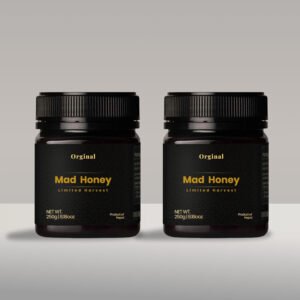
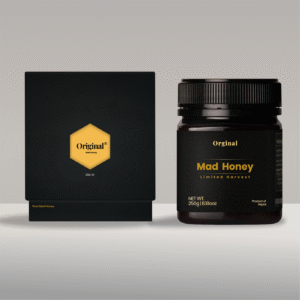
Hallucinogenic Honey: The Science, Effects & Ancient Truth Behind Nepal’s Rarest Elixir
Most people discover hallucinogenic honey the same way — a documentary, a news story, or a friend who tried it and could not quite explain what happened. The descriptions are always vivid: warmth, euphoria, a strange tingling, a feeling of being deeply relaxed and slightly outside of ordinary consciousness.
Then comes the question everyone asks next: is this real? Is honey actually capable of producing effects like that?
The answer — backed by peer-reviewed science, centuries of documented history, and the direct experience of thousands of customers we have served at Original Mad Honey — is yes. Completely, verifiably yes.
But the full story is more interesting than the headline. Here is everything you actually need to know about hallucinogenic honey from Nepal.
The Honey That Actually Changes How You Feel — Why Nepal's Mad Honey Is Different from Every Other Honey on Earth
Regular honey is a sweetener. Nepal’s hallucinogenic honey is something categorically different.
The distinction comes down to one compound: grayanotoxin — a naturally occurring diterpenoid neurotoxin found exclusively in the nectar of certain rhododendron species that grow at high altitude in the Himalayas.
When the giant Himalayan honeybee — Apis dorsata laboriosa — forages on these rhododendron flowers, the grayanotoxin from the nectar carries through into the honey. The result is a product that looks like honey, tastes broadly like honey, but produces a set of physiological and psychological effects that no other honey on earth can replicate.
This is not a matter of concentration or processing. You cannot create hallucinogenic honey by adding anything to regular honey. The grayanotoxin must come from the source — the specific rhododendron species, at the specific altitude, collected by the specific bee species that exists only in the Himalayas. Nepal, and to a lesser extent Turkey, are the only places on earth where these conditions exist together.
Grayanotoxin — The Compound That Makes Honey Hallucinogenic
The word “hallucinogenic” applied to mad honey is technically a simplification — but it points at something real.
Grayanotoxin does not produce full visual hallucinations in the way that classical psychedelics like psilocybin or LSD do. What it produces is something more subtle and, for many users, more profound: a deep alteration of physical sensation combined with a shift in mental state that sits somewhere between sedation and euphoria.
Here is the actual science of how it works.
How Grayanotoxin Affects the Nervous System
Grayanotoxin binds to voltage-gated sodium channels in nerve and muscle cells — the same channels that regulate electrical signaling throughout the body. Normally, these channels open briefly to allow sodium ions to flow in (which triggers a nerve signal) and then close immediately. Grayanotoxin prevents them from closing properly.
The result is that nerve cells remain in a partially activated state for longer than usual. Across the nervous system, this produces a cascade of effects:
- Peripheral vasodilation — blood vessels near the skin surface dilate, causing the characteristic warmth and tingling that users of hallucinogenic honey consistently describe
- Parasympathetic activation — the “rest and digest” nervous system response is amplified, producing deep physical relaxation and a slowing of heart rate
- CNS modulation — at sufficient doses, the effect reaches the central nervous system, producing the altered mental state — the mild euphoria, the perceptual shifts, the sense of being slightly removed from ordinary consciousness — that gives mad honey its reputation
This mechanism is well-documented in scientific literature. It is not speculation or anecdote. The grayanotoxin-sodium channel interaction has been studied in detail, and the physiological effects it produces are consistent and predictable at known doses.
3,000 Years of Documented Use — Hallucinogenic Honey in Nepal's History
Hallucinogenic honey from Nepal is not a modern discovery or a wellness trend. It has been known, used, and documented for at least three millennia.
The Gurung Honey Hunters of Lamjung
The Gurung people of Nepal’s Annapurna region have been harvesting mad honey from the sheer cliff faces of the Himalayas for generations stretching back before recorded history. Rock paintings found in the Annapurna foothills — estimated to be over 3,000 years old — depict honey hunters on rope ladders, harvesting from cliff-face hives.
For the Gurung, hallucinogenic honey is not a recreational product. It is a medicinal substance, a spiritual tool, and a cultural inheritance. Small doses have been used traditionally to manage hypertension, improve sleep, treat gastrointestinal conditions, and as part of ceremonial practice. The honey hunters themselves — the kuiche — hold a position of respected authority within their communities, and the harvest is preceded by ritual ceremonies that acknowledge the spiritual significance of what they are collecting.
The Mad Honey Massacre of 65 BCE
The most dramatic historical documentation of hallucinogenic honey’s power comes from ancient military history. In 65 BCE, the Roman general Pompey led his army through the Black Sea region in pursuit of King Mithridates of Pontus. Local villagers — fully aware of what they were doing — left combs of wild rhododendron honey along the army’s marching route.
The Roman soldiers consumed the honey enthusiastically. Within an hour, thousands of soldiers were incapacitated — unable to stand, disoriented, vomiting, their heart rates drastically slowed. Mithridates’ forces attacked and slaughtered them.
This event, documented by the Greek historian Strabo, is known as the Mad Honey Massacre — one of the earliest recorded uses of a natural psychoactive substance as a weapon. It is also the first written record of what we now understand to be grayanotoxin poisoning at scale.
What Hallucinogenic Honey From Nepal Actually Feels Like — A Factual Account
The effects of Nepal’s hallucinogenic honey are consistent, well-documented, and — at the right dose — genuinely remarkable. Here is an honest account of what users experience at different dose levels.
Low Dose — ¼ Teaspoon (1–2g)
Within 30–60 minutes:
- Gentle warmth spreading from the chest outward through the limbs
- Mild tingling in the lips, fingertips, and the back of the throat — a characteristic grayanotoxin signature
- A slight slowing of the heart rate — noticeable but not alarming
- A calm, grounded mental state — stress and tension recede noticeably
- Duration: 2–3 hours
This is where most first-time users should start. The effects are present and pleasant without being overwhelming.
Standard Dose — ½ to 1 Teaspoon (3–8g)
- Pronounced warmth and physical relaxation — muscles release tension throughout the body
- Mild euphoria — a genuine sense of wellbeing that is difficult to describe accurately without experiencing it
- Perceptual shifts — colors may appear slightly more vivid, sounds more textured; this is the closest mad honey gets to classical hallucinogenic effects
- Mental clarity paradoxically coexists with deep relaxation — many users describe feeling more present and aware, not foggy
- Duration: 3–6 hours
This is the dose range where Nepal’s hallucinogenic honey earns its reputation.
High Dose — Above 1.5 Teaspoons — Not Recommended
At doses above what the body can comfortably process, grayanotoxin poisoning sets in. Symptoms include severe dizziness, nausea, vomiting, dangerously low blood pressure, and very slow heart rate. This is not a pleasant experience and in severe cases requires medical attention.
The line between a profound experience and an unpleasant one is real. Respecting dosage is not optional — it is the entire difference between the two.
Nepal's Hallucinogenic Honey vs Other Psychoactive Substances — An Honest Comparison
People often ask how mad honey compares to other substances with psychoactive properties. It is a fair question, and the honest answer is: it is genuinely different from all of them.
Mad Honey (Grayanotoxin) | Cannabis (THC) | Psilocybin Mushrooms | Alcohol | |
|---|---|---|---|---|
Active Compound | Grayanotoxin | THC | Psilocybin | Ethanol |
Mechanism | Sodium channel modulation | CB1/CB2 receptor agonism | 5-HT2A receptor agonism | GABA/glutamate modulation |
Primary Effect | Relaxation, mild euphoria, physical warmth | Euphoria, altered perception | Strong hallucinations, ego dissolution | Disinhibition, sedation |
Hallucinations | Mild perceptual shifts at standard doses | Mild at high doses | Strong at standard doses | None to mild |
Legal Status (USA) | Legal in all 50 states | Varies by state | Federally illegal | Legal for adults |
Cardiovascular Effect | Lowers heart rate and blood pressure | Variable | Minimal | Raises heart rate |
Duration | 2–6 hours | 2–4 hours | 4–8 hours | 2–6 hours |
Addiction Potential | None documented | Low to moderate | None documented | Moderate to high |
Mad honey occupies a unique space — genuinely psychoactive, entirely legal, naturally occurring, and with a risk profile that is well-understood and manageable with correct dosage.
Is Hallucinogenic Honey from Nepal Legal?
Yes — in most of the world’s major jurisdictions.
In the United States, mad honey is legal in all 50 states. It is classified as a natural food product and grayanotoxin is not listed as a controlled substance by the DEA.
In the United Kingdom, Canada, Australia, Germany, France, and most of Europe, mad honey is legal to import, possess, and consume as a natural food product.
The legal status exists because mad honey is exactly what it appears to be: a naturally occurring honey that happens to contain a bioactive compound. It has not been manufactured, synthesized, or modified. The bees made it. The hunters collected it. It arrives at your door in the same state it left the cliff.
Why Most "Hallucinogenic Honey" Sold Online Is Not the Real Thing
The growing reputation of hallucinogenic honey from Nepal has created a predictable problem: a market flooded with fakes.
There are three categories of fake mad honey in circulation:
Category 1 — Regular honey sold as mad honey: No grayanotoxin, no effects. Just honey with a dramatic label.
Category 2 — Diluted mad honey: Real mad honey mixed with regular honey to increase volume. Some grayanotoxin present, but at such low concentrations that effects are negligible.
Category 3 — Low-altitude or off-season honey: Technically from rhododendron-foraging bees, but harvested at lower altitudes or outside peak bloom season where grayanotoxin concentrations are minimal.
Without laboratory analysis, it is essentially impossible to distinguish any of these from the genuine article by appearance or taste alone.
How Original Mad Honey Sources and Verifies Every Batch
At Original Mad Honey, we have built our entire operation around one commitment: complete transparency from the cliff face to your door.
Direct Sourcing from Lamjung, Nepal We work exclusively with Gurung honey hunting families in the Lamjung district — one of the highest-altitude and most potent hallucinogenic honey regions in Nepal. We have direct, long-term relationships with these communities. No brokers, no middlemen.
Laboratory Testing — Every Single Batch Every batch is tested for grayanotoxin I and III concentration, purity, and microbial safety before it leaves Nepal. We provide the lab certificate with every order.
QR Code Batch Verification Every jar carries a unique QR code. Scan it with your phone to view the specific lab results, harvest date, and hunter verification for your exact batch. No other mad honey seller offers this level of traceability.
4.9/5 Stars from Thousands of Customers Worldwide Our customers across more than 50 countries have verified the effects, the quality, and the authenticity of what we sell. That track record is not something that can be faked.
Safe Use Guidelines for Hallucinogenic Honey
Nepal’s hallucinogenic honey has been used safely for thousands of years. Responsible use means following dosage guidelines and understanding who it is and is not suitable for.
Dosage Guidelines
- First time: ¼ teaspoon on an empty stomach. Wait 60 minutes before any additional dose.
- Regular users: ½ to 1 teaspoon maximum in a single session
- Never exceed: 1.5 teaspoons in one sitting
Not Suitable For
- Pregnant or breastfeeding women
- Anyone under 18
- People with heart conditions or arrhythmia
- Anyone taking blood pressure medication or blood thinners
- People with naturally low blood pressure
Never Combine With
- Alcohol
- Blood pressure medication
- Heart medication
- Other psychoactive substances
Frequently Asked Questions
Is hallucinogenic honey from Nepal safe?
Yes, when consumed at correct doses. The Gurung people have used it safely for thousands of years. The key is starting low and respecting dosage limits. Our lab-tested batches include verified grayanotoxin concentration data so you always know exactly what you are consuming.
How long do the effects of hallucinogenic honey last?
At a standard dose of ½ to 1 teaspoon, effects last between 3 and 6 hours.
Is mad honey the same as hallucinogenic honey?
Yes. “Mad honey” and “hallucinogenic honey” refer to the same product — wild honey containing grayanotoxin from rhododendron-foraging bees in Nepal and Turkey. “Mad honey” is the most widely used name; “hallucinogenic honey” describes its effects.
Can I travel with hallucinogenic honey?
It is a legal food product in most countries. Within the USA, you can carry it in checked luggage. For international travel, check the import regulations of your destination country.
How do I know if my honey is genuinely hallucinogenic?
Buy from a seller who provides lab certificates showing grayanotoxin concentration. If a seller cannot provide this, there is no way to verify the honey’s potency or authenticity.