
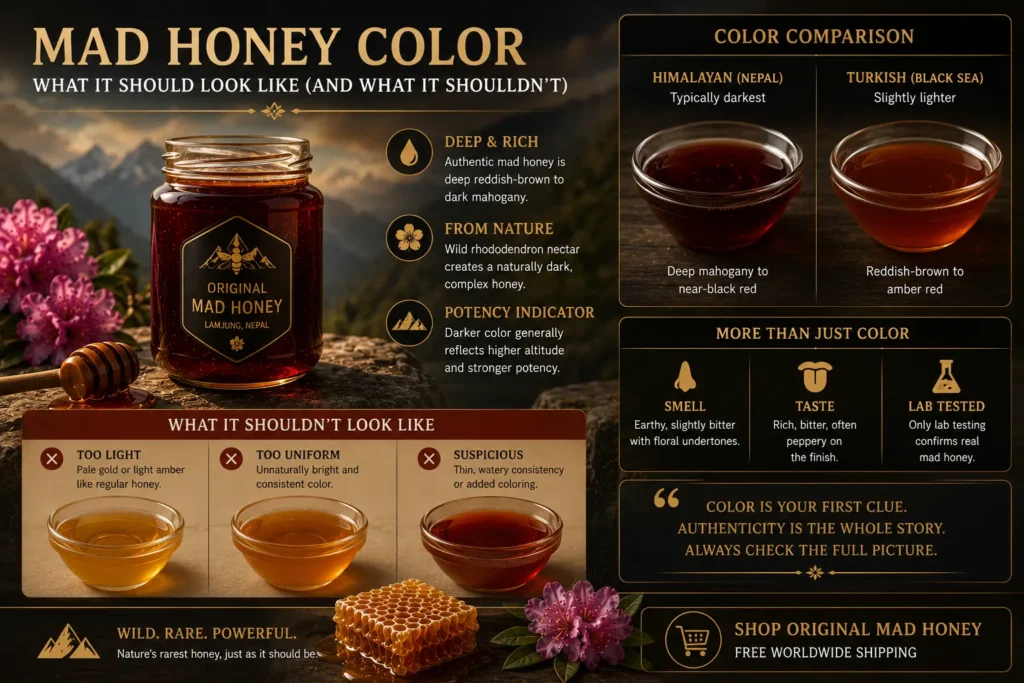
Before you even taste or smell mad honey, its color already tells you a lot. Genuine mad honey has a distinctive, unmistakable appearance — and because color is one of the easiest things to check before buying, it’s also one of the fastest ways to spot a fake.
What Color Is Real Mad Honey?
Authentic mad honey is typically deep reddish-brown to dark mahogany in color — noticeably darker than the golden amber tones of standard wildflower or clover honey. Held up to the light, it often shows deep garnet or burnt-orange undertones rather than the bright gold most people associate with honey.
This dark coloring comes directly from its source: wild rhododendron nectar, which produces a naturally darker honey than the mixed floral sources regular bees forage on. It’s covered in more detail in what is mad honey.
Why Mad Honey Is So Much Darker Than Regular Honey
Honey color is largely determined by its nectar source, and mineral and compound content of that nectar. Regular honey bees draw from dozens of different flowers — clover, wildflowers, orange blossom — which tend to produce lighter, more golden honey.
Mad honey comes from a single, unusual source: wild rhododendron flowers growing on Himalayan or Black Sea cliffs. That concentrated, single-flower origin — combined with the grayanotoxins and other plant compounds naturally present in rhododendron nectar — is what gives mad honey its signature dark, reddish-brown depth.
Does Color Vary Between Himalayan and Turkish Mad Honey?
Yes, slightly. As covered in Himalayan mad honey and Turkish mad honey, the two main sources can differ subtly in shade:
- Himalayan (Nepal) mad honey: Typically the darkest, often deep mahogany to near-black-red, reflecting its higher-altitude, more concentrated rhododendron source.
- Turkish mad honey: Often a slightly lighter reddish-brown, in line with its generally milder potency.
Neither is “wrong” — both fall within the authentic range — but a Himalayan mad honey that looks pale gold should raise questions.
Texture and Consistency
Color isn’t the only visual clue. Authentic mad honey tends to be:
- Thicker and denser than standard honey, often slower to pour
- Less prone to crystallizing quickly, though some crystallization over time is normal and not a sign of poor quality
- Slightly cloudier than filtered commercial honey, since it’s typically less processed
Red Flags: When Color Suggests a Fake
Because mad honey commands a premium price, dilution and mislabeling are common problems in the market. Watch for:
- Pale gold or light amber color — closer to standard wildflower honey than genuine mad honey, and a strong sign the product has been cut with regular honey or isn’t authentic at all.
- Unnaturally uniform, bright color — genuine wild-harvested honey usually shows some natural batch-to-batch variation; a color that looks too “manufactured consistent” can indicate blending.
- Thin, watery consistency paired with dark color — could indicate coloring has been added rather than the color coming naturally from rhododendron nectar.
Color alone can’t confirm authenticity — that requires lab testing for grayanotoxin content — but it’s a fast first filter before you even open the jar.
Color, Smell, and Taste Work Together
Color is most useful as part of a full authenticity check, alongside aroma and flavor:
- Smell: Earthy, slightly bitter, with floral undertones — see mad honey smell.
- Taste: Rich and bitter rather than sweet, often peppery on the finish — see what does mad honey taste like.
If a honey is dark in color but smells and tastes exactly like standard sweet honey, that mismatch is itself a warning sign.
See (and Taste) the Real Thing
Original Mad Honey is unfiltered, unprocessed, and true to its natural deep reddish-brown color — exactly what wild, cliff-harvested Himalayan mad honey should look like, verified batch by batch through lab testing.
Shop Original Mad Honey — Free Worldwide Shipping
FAQs
What color should real mad honey be?
Deep reddish-brown to dark mahogany — noticeably darker than typical golden wildflower or clover honey.
Why is mad honey darker than regular honey?
It comes from a single, unusual nectar source — wild rhododendron flowers — rather than the mixed floral sources regular honey bees use, which naturally produces a darker honey.
Is lighter-colored mad honey fake?
Not necessarily on its own, but a pale gold color is unusual for genuine mad honey and should be checked against smell, taste, and lab testing before assuming authenticity.
Does mad honey color change over time?
Some natural darkening or crystallization can occur with age and storage, but the base color should remain within the reddish-brown to mahogany range.
One comment
[…] Color: Deep reddish-brown to dark mahogany, much darker than typical wildflower honey. Read more on mad honey color. […]