Mad honey is consistently one of the most expensive honeys in the world — often many times the price of standard wildflower or clover honey. That price isn’t arbitrary, and it isn’t purely a marketing premium either. Here’s exactly what drives the cost, and how to know if what you’re paying for is genuine.
How Much Does Mad Honey Cost?
Prices vary by seller, region, and jar size, but authentic, lab-tested mad honey typically sits in a noticeably higher bracket than standard specialty honey — often several times the price of premium wildflower honey per gram. Himalayan mad honey from Nepal, particularly from well-documented regions like Lamjung, tends to command the highest prices, reflecting its potency and the difficulty of harvesting it.
At Original Mad Honey, our own pricing looks like this:
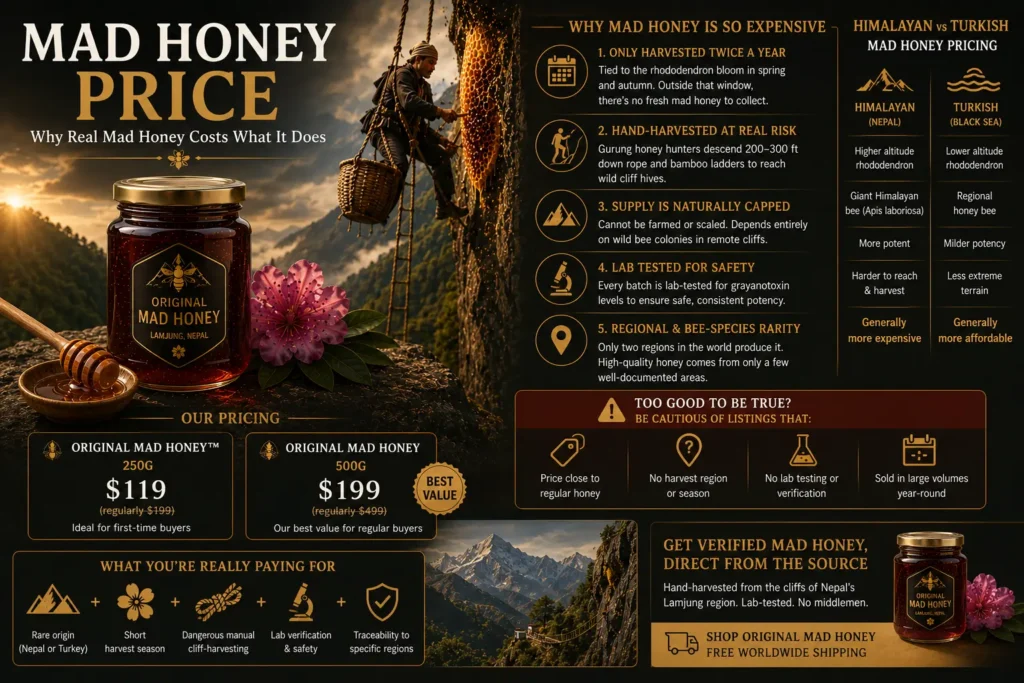
- Original Mad Honey™ – 250g — $119 (regularly $199), ideal for first-time buyers
- Original Mad Honey – 500g — $199 (regularly $499), our best value for regular buyers
Why Mad Honey Is So Expensive: 5 Real Reasons
1. It Can Only Be Harvested Twice a Year
Unlike commercial honey, which can often be extracted multiple times throughout the year, mad honey is tied to a narrow seasonal window — typically spring and autumn — when wild rhododendron flowers are actually in bloom. Outside that window, there’s simply no fresh mad honey to collect. Learn more in mad honey history.
2. Every Jar Is Hand-Harvested at Real Physical Risk
Mad honey isn’t extracted from managed hives at ground level. In Nepal, Gurung honey hunters descend 200–300 feet down handmade rope and bamboo ladders to reach wild hives built into cliff overhangs — a dangerous, skilled process passed down through generations. That labor and risk is priced directly into every jar. See Nepal mad honey for the full harvesting story.
3. Supply Is Naturally Capped
Mad honey can’t be farmed or scaled the way commercial honey can. It depends entirely on wild giant Himalayan bee colonies nesting on remote cliffs, or their Turkish counterparts along the Black Sea coast — covered in mad honey origin. There’s no version of increasing supply to meet demand; the ceiling is set by nature, not production capacity.
4. Authentic Mad Honey Requires Lab Testing
Because grayanotoxin content varies by batch, bloom, and region, responsible producers lab-test each harvest to confirm safe, consistent potency before it’s sold. This testing adds real cost that standard honey production doesn’t require, but it’s essential for both safety and authenticity.
5. Regional and Bee-Species Rarity
Only two regions in the world reliably produce genuine mad honey — Nepal’s Himalayas and Turkey’s Black Sea coast — and within those, the highest-quality honey comes from a small number of well-documented harvesting areas like Lamjung. That geographic scarcity keeps supply tight no matter how demand grows.
Himalayan vs. Turkish Mad Honey Pricing
Price can also reflect potency and origin. As covered in Himalayan mad honey and Turkish mad honey, Nepal’s Himalayan mad honey is generally considered more potent than Turkish mad honey, due to higher-altitude wild rhododendron and fully wild, harder-to-reach hives — which is often reflected in a higher price point for genuine Himalayan product.
How to Know If a Price Is Too Good to Be True
Because of how expensive authentic mad honey is to produce, unusually cheap “mad honey” is one of the clearest signs of dilution or mislabeling. Be cautious of listings that:
- Price mad honey close to standard wildflower or clover honey
- Don’t specify a harvest region or season
- Don’t mention lab testing or grayanotoxin verification
- Ship in large volumes year-round, which isn’t consistent with genuine seasonal, wild harvesting
Real mad honey’s price reflects real constraints — a listing that ignores those constraints is worth questioning before you buy.
What You’re Actually Paying For
When you buy genuine mad honey, the price covers the entire chain described across this guide: the Nepal or Turkey origin, the narrow harvest season, the manual cliff-climbing, the lab verification, and the traceability back to a specific region. It’s covered in full in what is mad honey.
Get Verified Mad Honey, Direct From the Source
Original Mad Honey is hand-harvested from the cliffs of Nepal’s Lamjung region, lab-tested batch by batch, and sold direct-from-source with no middlemen — so the price reflects the honey itself, not unnecessary markup.
Shop Original Mad Honey — Free Worldwide Shipping
FAQs
Why is mad honey so expensive compared to regular honey?
Limited seasonal harvesting, dangerous manual collection from wild cliffs, capped natural supply, and mandatory lab testing all add real cost that standard honey production doesn’t involve.
Is Himalayan mad honey more expensive than Turkish mad honey?
Often, yes. Himalayan mad honey is generally considered more potent and is harvested using more extreme, higher-altitude cliff-climbing methods, which tends to be reflected in price.
Is cheap mad honey a red flag?
Yes. Because of the real costs involved in authentic harvesting and lab testing, unusually low prices often indicate dilution, mislabeling, or non-authentic sourcing.
How much should I expect to pay for authentic mad honey?
Genuine, lab-tested mad honey typically costs significantly more per gram than standard specialty honey, reflecting its rarity, seasonality, and harvesting risk.