

Is Honey Good for You? 10 Health Benefits
Honey is good for you in a few specific ways, but it is not a health food. It can soothe a cough, help burns heal when doctors use medical grade
Honey is good for you in a few specific ways, but it is not a health food. It can soothe a cough, help burns heal when doctors use medical grade honey, and slightly improve some blood fat markers. It is also mostly sugar, so the benefits are small and the amount matters.
This guide ranks 10 health benefits of honey by how strong the evidence is. It shows the real numbers from the studies, explains the risks, and covers raw and manuka honey. Many readers also ask is mad honey good for you, so a full section near the end answers that. Last updated November 2026.
| Question | Answer |
|---|---|
| Is honey good for you? | In small amounts, yes. For a few uses, such as a cough, it can help. |
| Is honey healthy to eat every day? | It can fit, if you count it toward your daily sugar limit. |
| Is honey better than sugar? | Its glycemic index is lower, but both are free sugars. |
| Can honey treat a disease? | No. No study shows that honey cures one. |
| Who should never eat it? | Babies under 12 months. |
Is mad honey good for you? No. Mad honey carries a natural toxin called grayanotoxin, and no trial we read shows a health benefit. Read the mad honey section below before you try it.
We read the original research, not blog summaries. The main sources are two Cochrane reviews, a 2022 meta analysis of 18 trials, a 2021 review of 14 studies, and guidance from the American Heart Association, the British Heart Foundation and the FDA. We left out claims that rest only on animal studies or on seller pages. Where a source was weak or small, we say so.
Honey is mostly sugar, mainly fructose and glucose, with up to 20 percent water. Its small amounts of plant compounds change with the flowers the bees visit. According to the British Heart Foundation, honey gives no meaningful fiber, protein, fat, vitamins or minerals.
| Amount | Calories | Sugars |
|---|---|---|
| 1 teaspoon (7 g) | about 21 | about 6 g |
| 1 tablespoon (21 g) | about 64 | about 17 g |
The tablespoon figures come from a nutrition database, and the teaspoon figures come from the British Heart Foundation. A tablespoon holds 0 g of fiber, 0.1 g of protein and 0 g of fat.
Most honey benefits are small, so each one below comes with an evidence label. Read the label before you read the claim.
| # | Benefit | How strong is the evidence? |
|---|---|---|
| 1 | Helps burns and some wounds heal | Strong for burns, with medical grade honey only |
| 2 | Soothes cough and sore throat | Moderate, for short term relief |
| 3 | Slightly raises HDL cholesterol | High certainty, but a tiny effect |
| 4 | Slightly lowers triglycerides and cholesterol | Low certainty |
| 5 | May slightly lower fasting blood sugar | Low certainty, with signs of bias |
| 6 | Has a lower glycemic index than sugar | Measured, but honey is still sugar |
| 7 | May ease mouth sores after cancer treatment | Limited, under medical care |
| 8 | May help sleep when you are sick | Limited |
| 9 | Contains antioxidants | Present, but human benefit is unproven |
| 10 | Fights bacteria in the lab | Lab evidence only |
A Cochrane review of 26 studies with 3,011 people found that honey healed partial thickness burns about 4 to 5 days faster than usual dressings. That result has high certainty and comes from 2 trials with 992 people. The same review found that infected surgical wounds healed faster with honey than with an antiseptic wash and gauze, although that rests on one trial of 50 people. For leg ulcers and diabetic foot ulcers, the evidence was too weak to judge. You can read the Cochrane review on honey for wounds for the full detail.
What it means for you. These trials used sterilized medical grade honey in dressings applied by clinicians. Never put honey from your kitchen on a burn or a wound. See a doctor for any burn that blisters.
A Cochrane review of honey for cough in children covered 6 trials with 899 children aged 12 months to 18 years. Honey probably relieved cough better than no treatment, and better than a placebo for up to three days. Moderate certainty backs both results. After three days it showed no clear edge over a placebo. It made little difference compared with the cough medicine dextromethorphan, and most children received honey for only one night.
A 2021 review of 14 studies in people with upper respiratory infections reached a similar result. Honey beat usual care for cough frequency, cough severity and combined symptom scores. The authors rated the risk of bias as moderate and asked for better placebo controlled trials.
What it means for you. A spoon of honey in warm water or tea can soothe a scratchy throat. It is considered safe for anyone over 12 months. A British Heart Foundation dietitian points out that the evidence is thin and that warm drinks probably help too, so treat honey as a comfort, not a cure. See a doctor if a cough lasts, or if breathing is hard.
A 2022 meta analysis in Nutrition Reviews pooled 18 controlled trials with 1,105 people. You can read the full paper on honey and cardiometabolic risk factors. HDL, often called the good cholesterol, rose by 0.07 mmol/L on average, with high certainty. Raw honey showed a bigger rise of 0.11 mmol/L.
What it means for you. The effect is real but very small. It does not show that honey protects your heart.
The same analysis found that fasting triglycerides fell by 0.13 mmol/L, total cholesterol by 0.18 mmol/L and LDL cholesterol by 0.16 mmol/L. The certainty was low for all three. The LDL result lost its statistical weight when 6 trials were removed. Raw honey showed larger drops, but those figures rest on only 1 to 5 trials. The median trial lasted 8 weeks.
What it means for you. Honey is not a cholesterol treatment. Diet, exercise and medicine matter far more.
Across the trials, fasting glucose was 0.20 mmol/L lower with honey, with low certainty. The authors also found signs of publication bias. After adjusting for it, the drop shrank to 0.10 mmol/L and the range included no change at all.
What it means for you. Do not use honey to manage diabetes. A 2023 review of 48 clinical trials, summarized by the Hunter Medical Research Institute, says honey may sit beside regular medicine but never replace it.
The British Heart Foundation puts honey at a glycemic index of about 50, against about 80 for table sugar, because honey holds more fructose, which the body absorbs more slowly. The Hunter Medical Research Institute gives a range of 35 to 72 for Australian honeys and notes that most labels do not list it.
What it means for you. Honey raises blood sugar more gently than sugar, but it still raises it. It is not a better choice for people with diabetes, and some honey products contain added sweeteners that push the index up.
A 2023 review found that honey eased mouth ulcers and inflammation after chemotherapy or radiotherapy, and reduced some toxic effects of chemotherapy. The Hunter Medical Research Institute reports this as a possible help beside standard care.
What it means for you. Ask your cancer care team before you use honey in this way. This is medical use, not a kitchen remedy.
Five studies in children compared honey mixtures with cough medicine or no treatment, and each linked honey to better sleep and a milder cough. The amount and type of honey differed between studies. One trial of 68 hospital patients gave a milk and honey drink twice a day, and that group reported better sleep from day three. The patients knew what they were drinking, so bias is possible.
What it means for you. The evidence is limited. Honey contains traces of the sleep related chemicals melatonin and serotonin, but researchers judged the amounts too small to matter.
Honey holds plant compounds such as phenolic acids and flavonoids, and darker honeys tend to hold more. That is real chemistry. Whether it helps a person is not proven. The British Heart Foundation says honey holds only trace antioxidants and that there is no strong evidence for benefits to the heart, digestion, immunity or memory. It adds that you would need about 80 g a day to reach any possible benefit, and that much sugar would cancel it out.
What it means for you. Berries, nuts and vegetables give far more antioxidants with far less sugar.
A 2020 review found that manuka and medical grade honeys worked against most of the multidrug resistant bacteria tested. Lab dishes are not human bodies, so this result does not mean that eating honey treats an infection.
What it means for you. Use medicine for infections. Doctors may use medical grade honey on wounds, as in benefit 1.
The 2022 trials used a median of 40 g of honey a day, within a range of 5 g to 125 g. Forty grams is about 2 tablespoons. That gives you roughly 120 calories and 33 g of sugar.
The American Heart Association advises women to keep added sugar to 100 calories a day, about 6 teaspoons, and men to 150 calories, about 9 teaspoons. Honey counts as an added sugar. So the amount that gave small gains in trials would use up most of your daily sugar allowance, or more. This is why the benefits do not justify eating a lot of honey.
| Honey | Table sugar | |
|---|---|---|
| 1 teaspoon | 7 g, about 21 calories, about 6 g sugars | 4 g, about 16 calories, 4 g sugars |
| Glycemic index | About 50 | About 80 |
| Fiber, vitamins, minerals | Trace | None worth counting |
| Counts as free sugar | Yes | Yes |
The verdict is simple. Honey has a slight edge on glycemic index and a pleasant taste, but both are free sugars with little nutrition. Swapping sugar for honey helps only if you end up using less of it. Our guide to honey benefits for men covers the men’s health angle.
Raw honey. The benefits of raw honey look larger on paper. In the 2022 analysis, raw honey showed larger gains in glucose, total cholesterol, triglycerides and HDL than honey overall. Those results come from a handful of small trials, and 20 of the 33 comparisons did not report how the honey was processed. Raw honey is strained and not heavily heated or finely filtered, and our guide explains what raw honey is. Raw unfiltered honey benefits are still unproven, because we found no trial that shows it is healthier. Raw honey is also not safe for babies under 12 months.
Manuka honey. The evidence for manuka comes from wound care and lab studies, not from eating it. We found no strong trial showing that eating manuka beats other honey, and it costs much more.
Other types. Clover and robinia honeys showed benefits for glucose or blood fats in a few trials. You can compare them in our guide to the types of honey.
Honey counts toward your daily limit of added sugar, along with sugar from every other food. These figures come from the American Heart Association and the British Heart Foundation, and the honey amounts are our own conversions at 6 g of sugar per teaspoon.
| Who | Daily limit | Honey, if it were your only added sugar |
|---|---|---|
| Women, American Heart Association | About 25 g | About 4 teaspoons |
| Men, American Heart Association | About 37.5 g | About 6 teaspoons |
| Adults, British Heart Foundation | 30 g free sugars | About 5 teaspoons |
In real life you also eat sugar in cereal, drinks and sauces. A teaspoon or two of honey a day fits most diets. Keep it as a sweetener, not a supplement.
No, not in the way ordinary honey is. Mad honey comes from rhododendron nectar and carries grayanotoxin. A scientific review of grayanotoxin poisoning describes dizziness, low blood pressure and a heart rhythm problem called atrioventricular block. It says human poisoning is rarely fatal, and that evidence for medical use is scarce and may be harmful.
We sell mad honey, so we say this plainly: it is not a health food, and nothing here is a reason to try it. Our overview of what mad honey is explains the basics, and the warning signs are listed under mad honey side effects. Do not use it if you are pregnant or breastfeeding, if you have a heart condition, if you take heart or blood pressure medicine, or if you are under 18. If you feel unwell after any honey, call Poison Help at 1-800-222-1222.
Not in any way that research supports. Mad honey has a long history of traditional use in Nepal and Turkey, and sellers often link it to energy, pain relief or sexual health. We found no clinical trial that backs those claims. The only research we found describes poisoning.
Grayanotoxins stop sodium channels in nerve cells from closing properly, which keeps the vagus nerve more active. That nerve slows the heart and relaxes blood vessels, which explains the main symptoms. Reports list nausea, dizziness, low blood pressure and a slow heart rate. Serious cases can bring nerve problems and a dangerous heart rhythm. The review says death is rare, but it does happen.
We cannot know how much grayanotoxin sits in an untested jar. That is why a small first amount and a batch lab report matter.
| Ordinary honey | Mad honey | |
|---|---|---|
| Bees make it from | Many kinds of flowers | Rhododendron nectar |
| Natural compound of concern | None notable | Grayanotoxin |
| Benefits shown in studies | Cough relief and, in medical grade form, burn healing | None we could find |
| Main risks | Sugar, and botulism in babies | Dizziness, low blood pressure, heart rhythm problems |
| Everyday use | Yes, in small amounts | No |
Our guideline is a quarter teaspoon, then a wait of 2 hours, and never more than half a teaspoon in a day. These are company guidelines, not medical doses, and our mad honey dosage guide explains the reasoning. Buy only a batch with a lab report. Our guide on whether mad honey is legal in the USA explains why you can buy it, but legal does not mean safe.
If you feel faint, stop eating it, sit or lie down and call Poison Help. Call 911 for chest pain, a very slow heartbeat or trouble breathing.
Is honey good for you every day?
A teaspoon or two fits most diets if you count it toward your sugar limit. Eating a lot every day adds sugar and calories with no proven gain.
Is honey healthy?
It has small, real benefits and a lot of sugar. It is a sweetener with a few useful extras, not a superfood.
Why is honey good for you?
It can soothe a cough, medical grade honey helps burns heal, and trials show tiny gains in HDL cholesterol and triglycerides. None of these makes it a health food.
Is raw honey good for you?
Raw honey showed larger changes in a few small trials, but the evidence is low certainty. It is also not safe for babies under 12 months.
What are the benefits of raw unfiltered honey?
No trial we read proves that unfiltered honey is healthier than other honey. It does keep more of its natural particles, which some people like for taste and texture.
Is manuka honey good for you?
The evidence for manuka comes from wound dressings and lab tests. We found no strong trial showing that eating it works better than other honey.
Is Honey Nut Cheerios good for you?
A cereal flavored with honey is still a sweetened cereal. Check the label for added sugar per serving and compare it with plain cereals.
Is honey better than sugar?
Slightly, because of its lower glycemic index. Both are free sugars, so the gain is small.
Is honey good for diabetes?
No. It raises blood sugar and counts as sugar. Talk to your doctor before you change your diet.
Is honey good for a sore throat or cough? It can soothe both for a short time, and it is considered safe for anyone over 12 months. See a doctor if symptoms last or breathing is hard.
Can babies have honey?
No. Never give honey to a baby under 12 months because of the risk of infant botulism.
How much honey is safe a day?
There is no official honey limit. Keep all added sugar within the daily limits above, which means about 1 to 2 teaspoons of honey for most people.
Is mad honey good for you?
No. Mad honey carries grayanotoxin, which can cause dizziness, low blood pressure and heart rhythm problems. No trial we read shows a health benefit.
What does mad honey do to your body?
Grayanotoxin keeps the vagus nerve more active, which can slow the heart and lower blood pressure. Symptoms include nausea, dizziness and a slow heartbeat.
Is mad honey the same as regular honey?
No. Bees make both, but mad honey comes from rhododendron nectar and carries grayanotoxin, while ordinary honey does not.
Disclosure: Original Mad Honey sells mad honey. This guide is about ordinary honey, and we wrote it from the sources listed below, not from our product claims.
This article gives general information and is not medical advice. Speak to your doctor before you use honey to treat any condition, and before you change your diet if you have diabetes or a heart condition.
Honey is good for you in a few specific ways, but it is not a health food. It can soothe a cough, help burns heal when doctors use medical grade

Mad honey is legal to buy and own in Texas, based on the laws I checked. Texas does not list grayanotoxin, the natural compound in mad honey, as a controlled
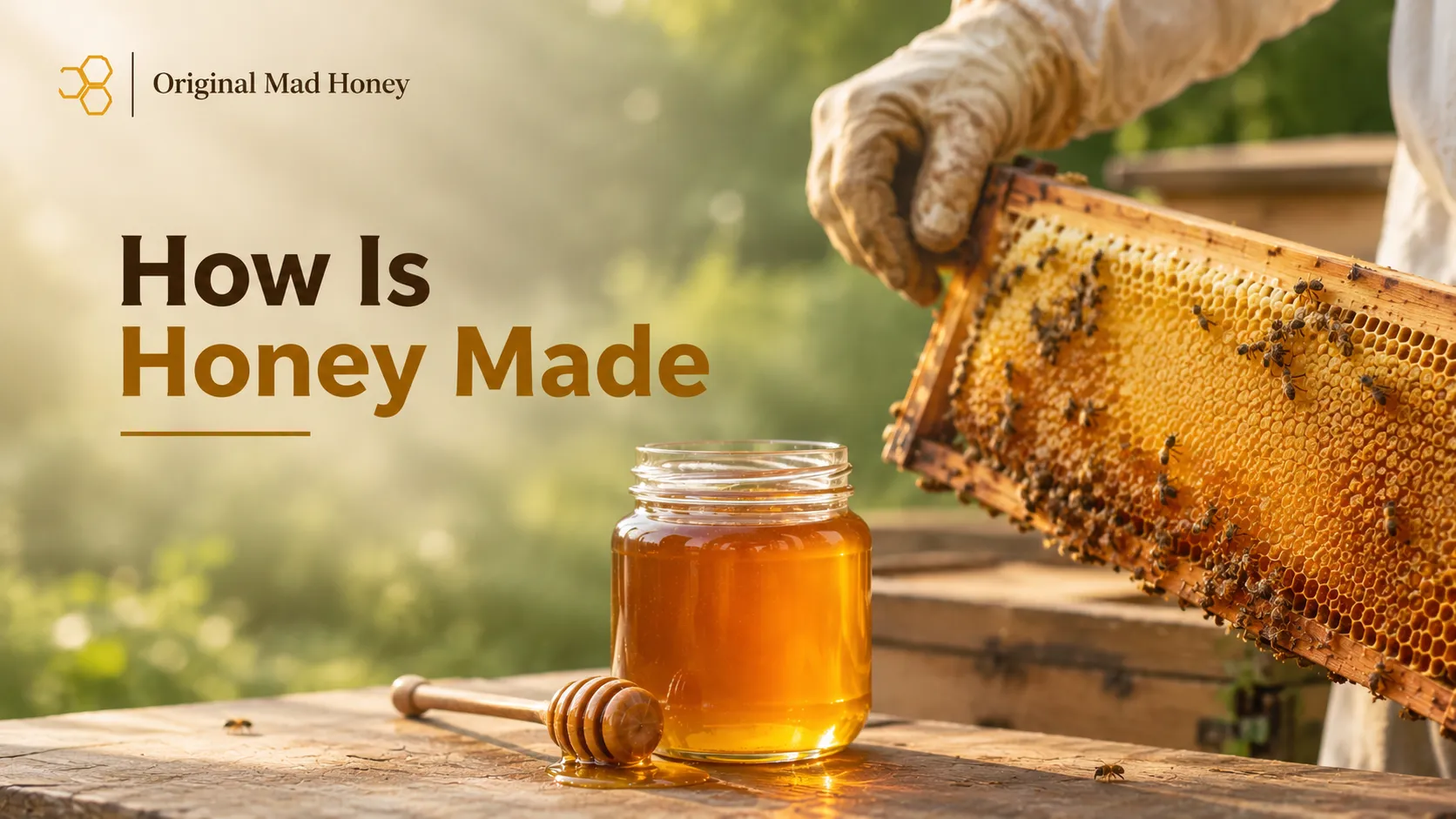
Honey is made by bees. Foragers collect flower nectar, house bees add enzymes and dry it in the hive, and the finished honey is sealed in wax. Beekeepers then spin