

How Long Does Honey Last? Shelf Life, Storage Tips, and Signs of Spoilage
Honey that is sealed, dry and clean can last for years, and well kept pure honey can stay usable long after the date printed on the jar. That is the
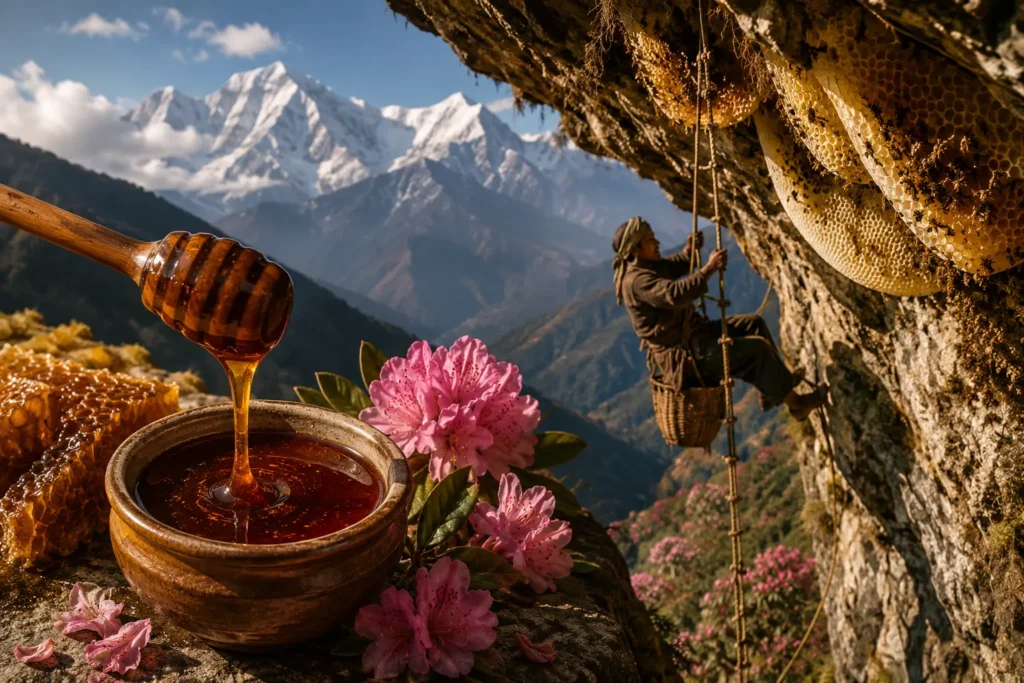
Mad honey is a rare, wild harvested honey made by bees that feed on certain rhododendron flowers in the mountains of Nepal and, less commonly, along the Black Sea coast of Turkey. Unlike ordinary honey, it contains a naturally occurring compound called grayanotoxin, which comes directly from the flower’s nectar and gives the honey a bitter taste along with a mild, dose dependent effect on the body. It is not a drug, it is not artificially flavored, and it cannot be produced from bees fed sugar syrup. It exists only because bees forage on a specific wild plant, and someone was willing to climb a cliff to collect it.
That short answer covers the basics, but what Is Mad Honey is one of those subjects where almost every article online repeats the same three facts and calls it a day. This guide goes further. We will cover what honey is made of in general, what actually separates mad honey from every other honey on a store shelf, where it truly comes from, how it is harvested, what it looks and tastes like, what its effects really are, and how to avoid buying a fake.
Before getting into what makes mad honey unusual, it helps to understand ordinary honey first, since most people have never actually looked into what is in the jar on their kitchen shelf.
Honey begins as flower nectar, a thin, sugary liquid collected by worker bees. Back at the hive, bees pass the nectar between one another, adding an enzyme called invertase that breaks the complex sugar sucrose down into two simpler sugars, glucose and fructose. The bees then fan the nectar with their wings to evaporate excess water, turning a thin liquid that started out around 70 to 80 percent water into the thick, syrupy honey we recognize, which typically ends up around 17 percent water.
A typical jar of honey is roughly 38 to 40 percent fructose and 30 to 32 percent glucose, with the remainder made up of water, trace amounts of sucrose and maltose, organic acids, minor proteins, enzymes, and small amounts of vitamins and minerals. The exact flavor, color, and composition shifts depending on which flowers the bees visited, which is why clover honey, wildflower honey, manuka honey, and mad honey all taste and behave differently despite sharing the same basic sugar backbone.
What is honey mustard made of? Honey mustard is not a type of honey at all, it is a condiment made by blending honey with prepared mustard, usually Dijon or yellow mustard, sometimes with a splash of vinegar or mayonnaise added for texture. The honey provides sweetness to balance the sharp, tangy heat of the mustard seed.
What is hot honey made of? Hot honey is regular honey infused with chili peppers, typically steeped or blended together along with a small amount of vinegar to balance the sweetness and preserve the mixture. Despite the name, hot honey has no relation to mad honey. Its heat comes from capsaicin in the peppers, not from any compound naturally present in the honey itself.
Both of these are manufactured condiments built around ordinary honey. Mad honey, by contrast, is not blended or flavored with anything. Its distinct qualities come entirely from what the bees themselves foraged on in the wild.
The defining feature of mad honey is grayanotoxin, a naturally occurring compound found in the nectar, pollen, and leaves of certain rhododendron species. When bees forage heavily on these flowers, trace amounts of grayanotoxin end up concentrated in the honey they produce.
Grayanotoxin works by binding to sodium channels in the body’s cells and keeping them open longer than normal. This is why mad honey can produce warmth, mild euphoria, or lightheadedness in small doses, and more uncomfortable symptoms like dizziness, nausea, and a drop in blood pressure in larger ones. You can read a full scientific breakdown on our dedicated grayanotoxin page.
In Nepal, the rhododendron most closely tied to mad honey is Rhododendron arboreum, known locally as Lali Gurans and recognized as the country’s national flower, along with several of the more than thirty other rhododendron species found across Nepal’s mid hills and high hills. This is worth correcting clearly, since a lot of older articles online borrow the Turkish species names, Rhododendron ponticum and Rhododendron luteum, and apply them to Nepal as well. Those two species are specific to the Black Sea region of Turkey and the Caucasus. Nepal’s mad honey comes from its own native rhododendron forests, not imported plant species. You can see photos and details of the actual flowers behind Nepal’s harvest on our rhododendron flowers page.
Ordinary commercial honey almost never contains meaningful grayanotoxin, because bees kept in managed hives are typically placed near a wide mix of crops and flowers, which dilutes any single toxic nectar source. Mad honey only becomes potent in places where rhododendron dominates the landscape so heavily that bees have little else to forage on.
Mad honey is produced in two main regions of the world, and they are not the same product.
| Feature | Nepal | Turkey |
|---|---|---|
| Bee species | Apis laboriosa, the Himalayan giant honeybee | Apis mellifera, the common honeybee |
| Main rhododendron species | Rhododendron arboreum and other Himalayan species | Rhododendron ponticum and Rhododendron luteum |
| Harvest method | Wild cliffside combs, climbed by hand using rope ladders | Managed hillside hives near the Black Sea coast |
| Harvest regions | Lamjung, Kaski, Gorkha, and nearby hill districts | Kaçkar Mountains, Black Sea coastal provinces |
| Local name | Mad honey, or occasionally cliff honey | Known locally as deli bal |
| Harvest frequency | Twice yearly, spring and autumn | Once yearly, tied to a short spring bloom |
Nepal’s version is considered the wilder and more traditional of the two, since it depends entirely on untamed cliff colonies rather than managed apiaries. You can read more about the Nepal side of the story on our Nepal mad honey and Himalayan mad honey pages.
Nepal’s mad honey exists because of a genuinely unusual partnership between one plant and one insect.
Apis laboriosa is the largest honeybee species in the world, capable of building open air combs over a meter across on the faces of steep, south facing cliffs at elevations between roughly 2,000 and 3,500 meters. Unlike the honeybees used in commercial apiaries worldwide, Apis laboriosa has never been successfully domesticated. It cannot be kept in a wooden hive box, moved to a farm, or bred for higher output. It exists only in the wild, which is a large part of why mad honey remains genuinely rare rather than simply expensive.
Twice a year, when Nepal’s rhododendron forests burst into bloom, these bees forage almost exclusively on the abundant flowers around them. Because rhododendron can dominate entire hillsides in these regions, the bees end up concentrating unusually high levels of grayanotoxin in the honey they store, far more than a bee visiting a wide mix of ordinary garden and crop flowers ever would.
Because the bees cannot be domesticated, collecting their honey requires physically reaching a wild comb on an exposed cliff face, which is exactly as dangerous as it sounds. Hunters from the Gurung ethnic community, who have practiced this tradition for generations, descend hundreds of feet on handmade bamboo and rope ladders, use smoke to calm the colony, and cut the comb free with a long bladed pole before lowering it to the ground for straining.
This entire process cannot be mechanized or scaled, which is why authentic mad honey will always be limited by how much a small number of trained hunters can safely collect in a short seasonal window. Our full breakdown of the process, step by step, is available on our how is mad honey harvested page, and you can learn more about the hunters themselves on our Gurung honey hunters page.
Real mad honey looks noticeably different from a jar of clover or wildflower honey. It tends to be darker, ranging from deep amber to a reddish brown, and it is often thinner and runnier in texture rather than thick and syrupy, particularly in honey harvested during peak spring bloom.
The taste is where mad honey really sets itself apart. Instead of the clean, straightforward sweetness of ordinary honey, mad honey carries a distinct bitterness alongside its sweetness, sometimes described as earthy, herbal, or slightly medicinal. The smell often reflects this as well, with a more pungent, almost woody aroma compared to the light floral scent of standard honey. None of this is a defect. It is a direct reflection of the rhododendron nectar the bees were feeding on, and honey that tastes purely sweet with no bitterness at all is a sign it may not be a genuine harvest.
This is where a lot of online content gets sloppy, so it is worth being precise. Mad honey is often described as hallucinogenic honey or honey that gets you high, and while there is a kernel of truth in both phrases, the reality is more modest than the internet’s favorite headlines suggest.
In small doses, typically half a teaspoon to one teaspoon for a first time user, mad honey can produce a mild warmth, a light headed or slightly relaxed feeling, and occasionally a subtle sense of euphoria. This is the effect most people who buy mad honey are actually looking for, and it is genuinely real, backed by the way grayanotoxin interacts with sodium channels in the nervous system.
True hallucinations, the kind involving vivid visual or auditory distortion, are uncommon and generally only associated with excessive overconsumption, well beyond any recommended serving. Most documented cases of severe symptoms in medical literature involve people who consumed several tablespoons at once, not a measured, cautious dose. So while the label hallucinogenic honey is technically defensible at very high doses, calling it accurate for a typical serving size is an overstatement that has followed mad honey around for years, largely thanks to sensational headlines rather than clinical reality.
At higher doses, the more common and better documented effects include dizziness, nausea, excessive sweating, and a drop in both heart rate and blood pressure, sometimes serious enough to require medical attention. Our mad honey side effects page goes into detail on what to watch for and when to seek help.
Used carefully, in small measured amounts, mad honey has a long history of traditional use in both Nepal and Turkey without major incident. It is a natural food product, not a synthetic drug, and its risk profile is directly tied to dose rather than to the honey being inherently dangerous in any amount.
That said, safety depends heavily on getting the serving size right, since grayanotoxin concentration varies noticeably between a spring harvest and an autumn harvest, and even between individual cliffs and colonies. A cautious starting dose for a healthy adult is generally around half a teaspoon, with a full teaspoon considered a moderate serving once tolerance is understood. Our mad honey dosage guide walks through recommended amounts in more detail.
Certain groups should avoid mad honey entirely, including anyone who is pregnant, anyone taking blood pressure medication, anyone with an existing heart condition, and children of any age. If you are unsure whether mad honey is appropriate for your situation, speaking with a doctor before trying it is a reasonable precaution, not an overreaction.
Because genuine mad honey requires a dangerous, low yield harvest, it is also one of the more commonly faked specialty foods sold online. A few checks can help separate the real thing from a diluted or entirely synthetic imitation.
Real mad honey cannot come from bees fed sugar syrup. Grayanotoxin only enters honey through rhododendron nectar, so any product that tastes purely sweet with no bitterness at all, or is suspiciously cheap for the amount offered, was almost certainly never harvested from wild bees at all.
A trustworthy seller will be specific about harvest season and origin, rather than offering a vague, unlimited supply available every month of the year. Since harvesting only happens twice yearly, a legitimate batch should be tied to a spring or autumn harvest from a named region in Nepal.
Lab testing is one of the clearest signs of a transparent seller, since grayanotoxin content genuinely varies by batch and cannot be guessed at reliably. A seller who can show actual test results for the specific batch you are buying is offering real accountability rather than a marketing claim.
Finally, ask where the honey actually comes from. A seller sourcing directly from Gurung hunters should be able to name the district, describe the harvest, and explain how the honey traveled from the cliff to the bottle. Vague sourcing usually means the honey passed through several unnamed middlemen, if it is authentic at all.
What is mad honey?
Mad honey is a rare, wild harvested honey produced by bees foraging on rhododendron flowers, primarily in Nepal and parts of Turkey. It contains grayanotoxin, a natural compound that gives the honey a bitter taste and mild, dose dependent effects on the body.
Is mad honey actually hallucinogenic?
At typical, cautious serving sizes, mad honey produces mild warmth, relaxation, and sometimes light euphoria rather than true hallucinations. Genuine hallucinogenic effects are rare and generally only occur after significant overconsumption, well beyond a normal dose.
What is honey made of in general?
Ordinary honey is mainly a mixture of fructose and glucose, roughly 38 to 40 percent and 30 to 32 percent respectively, along with water, trace organic acids, enzymes, and small amounts of vitamins and minerals, all derived from flower nectar processed by bees.
Is hallucinating honey the same as mad honey?
Yes, hallucinating honey and mad honey refer to the same product. The name reflects its historical reputation more than its typical effects, since real hallucinations are uncommon outside of significant overconsumption.
Where does real mad honey come from?
Authentic mad honey comes from wild cliff colonies of the Himalayan giant honeybee in the hill districts of Nepal, particularly Lamjung, Kaski, and Gorkha, as well as from managed hillside hives near the Black Sea coast of Turkey.
Can mad honey be made artificially or from sugar syrup?
No. Grayanotoxin only enters honey through bees foraging on rhododendron nectar in the wild. Honey made from bees fed sugar syrup contains no grayanotoxin and cannot be considered real mad honey, regardless of how it is labeled.
Is mad honey legal to buy?
Mad honey is legal to buy and sell as a food product in most countries, including the United States, though a few countries restrict or ban its sale. Always check your local regulations before ordering.
Mad honey is not a myth, a marketing gimmick, or an internet exaggeration, but it is also not the wild hallucinogen some headlines make it sound like. It is a real, rare, wild harvested honey shaped by a specific bee, a specific flower, and a harvest tradition that has barely changed in centuries.
At Original Mad Honey, every batch we sell is sourced directly from Gurung honey hunters in Lamjung, Nepal, tracked by harvest season, and lab tested for grayanotoxin content before it reaches our customers. If you are ready to see current batches, you can browse our shop page and start with a cautious, informed first dose.
Honey that is sealed, dry and clean can last for years, and well kept pure honey can stay usable long after the date printed on the jar. That is the
There are four ways to sort the types of honey: by the flower the bees visited, by color, by form such as raw or creamed, and by the species of
Honey benefits for men are real but modest. The best human evidence shows that honey can lower fasting blood sugar and cholesterol when it replaces other sugar, and that it