

How Long Does Honey Last? Shelf Life, Storage Tips, and Signs of Spoilage
Honey that is sealed, dry and clean can last for years, and well kept pure honey can stay usable long after the date printed on the jar. That is the
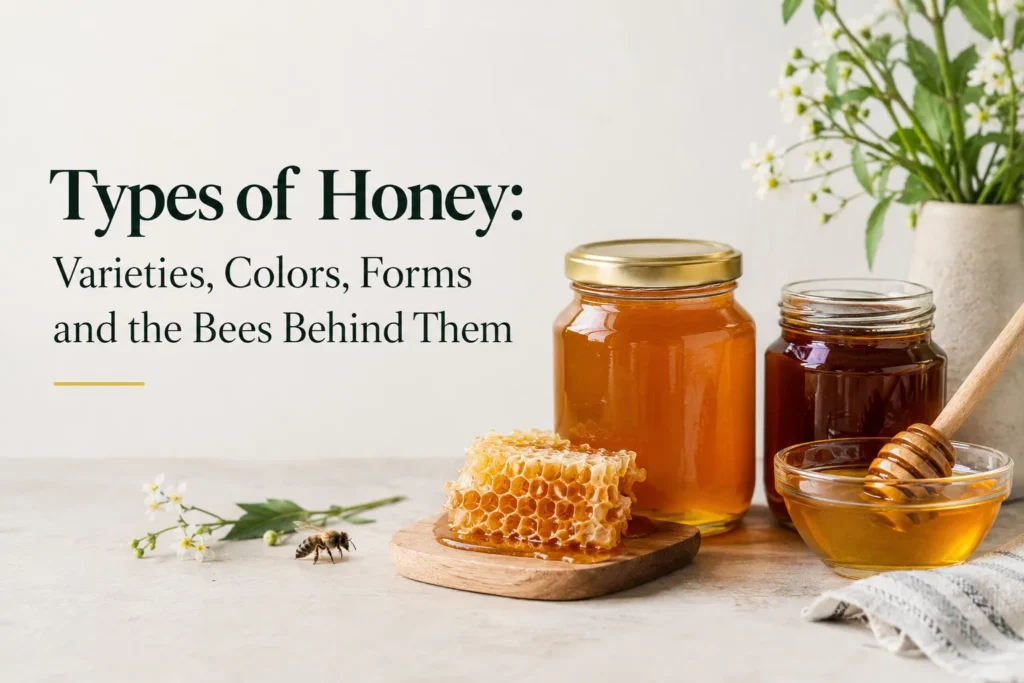
There are four ways to sort the types of honey: by the flower the bees visited, by color, by form such as raw or creamed, and by the species of bee that made it. Most pages that list different types of honey cover only the first. This guide covers all four, then answers the questions people ask next, including what type of sugar honey is and which type is the healthiest.
The short answers are these. No one can name an exact number of honey types, because honey can come from more than 300 plants in the United States alone. Honey is mostly fructose and glucose with about 17 percent water. No trial has ranked the types by health benefit, but raw honey and darker honey have the best support. Original Mad Honey sells wild harvested honey from Nepal, so we have a commercial interest in honey. Every figure below traces to a government agency, a university, an industry standard or a journal.
This types of honey chart uses the descriptions in the National Honey Board varietal guide, an industry reference. Color and flavor vary by region and harvest.
| Honey type | Color and flavor |
|---|---|
| Clover | Sweet, flowery aroma and a pleasingly mild taste |
| Wildflower | Amber to dark amber, with mild floral overtones |
| Orange blossom | White to extra light amber, sweet and fruity with a flowery aftertaste |
| Alfalfa | White or extra light amber, mild, with a flavor like beeswax |
| Fireweed | Water white, delicate, with subtle tea like notes |
| Tupelo | Light amber, very sweet, with complex floral, herbal and fruity flavors |
| Sage | Sweet and clover like, with an elegant floral aftertaste |
| Avocado | Dark amber, rich, with notes of caramelized molasses |
| Buckwheat | Dark, with strong molasses and malt flavors |
| Manuka | Defined by laboratory tests, not by taste (see the flower section below) |
| Mad honey | Made from rhododendron nectar and carries a toxin (see the warning section below) |
No official count exists. The University of Arizona Cooperative Extension says honey can come from more than 300 different plants in the United States, and each plant gives nectar with its own flavor (University of Arizona). That is why the question what types of honey are there gets answers that run from 7 types to 44 types in the pages we read. Those pages list different slices of one large field.
The National Honey Board makes the first split. Floral honey comes mainly from flower nectar, and non floral honey comes from other sources such as honeydew, the sweet deposit left on plants by sap sucking insects like aphids. The rest of this guide sorts floral honey further.
Monofloral honey takes its name from one main flower, such as clover or orange blossom, and most honey varieties follow that naming habit. Wildflower honey comes from many flowers, so it changes with region and season. The University of Arizona notes that grocery honey is often a blend of wildflower or clover, chosen for a steady light color and a mild taste. A flower name on a label also has to be true. The FDA says a seller does not have to declare the floral source, but may name it, for example clover honey, if the claim is truthful and supported (FDA).
Clover honey comes mostly from clover nectar and tastes mild and sweet. Wildflower honey comes from a mix of flowers, runs amber to dark amber and tastes mildly floral. The real difference in wildflower vs clover honey is the number of flowers, not quality. Clover gives a predictable mild taste. Wildflower gives more variation from jar to jar.
Manuka honey is the type most defined by testing. New Zealand’s Ministry for Primary Industries identifies it through five attributes, four chemicals from nectar and one DNA marker from manuka pollen, and it classes the honey as monofloral or multifloral. All honey labeled manuka for export must be tested by a recognized laboratory (MPI).
Form describes what was done to the honey after the bees made it. These definitions come from the National Honey Board.
Clover honey vs raw honey is not a fair contest, because the two words answer different questions. Clover tells you which flower the nectar came from. Raw tells you the honey was not heated. One jar can be both. A jar of clover honey can be pasteurized, and a jar of raw honey can be wildflower. The FDA labeling guidance does not define raw, so read the label for both words.
The USDA standard sorts honey into seven color classes on the Pfund scale, measured in millimeters. A lower number means a lighter honey (USDA Agricultural Marketing Service).
| USDA color class | Pfund scale (mm) |
|---|---|
| Water white | 8 or less |
| Extra white | Over 8 to 17 |
| White | Over 17 to 34 |
| Extra light amber | Over 34 to 50 |
| Light amber | Over 50 to 85 |
| Amber | Over 85 to 114 |
| Dark amber | Over 114 |
Color class is separate from grade. The same standard sets U.S. Grade A at a minimum score of 90 points, Grade B at 80 and Grade C at 70, and Grade A and B honey can hold at most 18.6 percent moisture.
Color also hints at taste. Lighter honeys generally taste milder, and darker honeys taste stronger and, according to the University of Arizona, contain more minerals and antioxidants. Fireweed and alfalfa sit at the pale end of the chart above. Buckwheat and avocado sit at the dark end.
The questions what types of bees make honey and what are the 4 types of honey bees have a clear answer in the Food and Agriculture Organization’s guide to the genus Apis. It says at least four species are commonly recognized, and it mentions a fifth, Apis laboriosa, as recently confirmed from Nepal (FAO).
| Species | Common name | Where it lives | How it nests |
|---|---|---|---|
| Apis mellifera | Common or European honey bee | Europe, Africa, parts of western Asia and the Americas | Many combs inside dark cavities |
| Apis cerana | Asian or oriental honey bee | Tropical, subtropical and temperate Asia | Many combs inside dark enclosures |
| Apis dorsata | Giant or rock honey bee | Pakistan east to Indonesia | One open comb hung high in the air |
| Apis florea | Dwarf honey bee | Oman and Iran east to Indonesia | One open comb camouflaged by leaves |
| Apis laboriosa | Himalayan giant honey bee | The Himalayas, including Nepal | One large comb under cliff overhangs, at 2,500 to 3,000 meters |
The Apis laboriosa row comes from a separate reference, which says the species nests on vertical cliff faces (Wikipedia). Some stingless bees also make honey, and a 2022 review in Molecules discusses stingless bee honey. Honey from bees of one species still varies by flower, so the species alone does not tell you what is in the jar.
The phrase three types of honey bees usually means the three castes inside one colony. Iowa State University Extension describes them this way. One queen lays up to 2,000 eggs a day. Workers, all female, make up most of the hive and forage for nectar and pollen. A few drones, all male, exist to mate with new queens. A hive can hold up to 60,000 bees (Iowa State University Extension).
Honey is mostly two simple sugars, fructose and glucose, dissolved in water. The National Honey Board gives these averages: moisture 17.2 percent, fructose 38.4 percent and glucose 30.3 percent, with a typical fructose to glucose ratio of 1.23 (National Honey Board). So when readers ask what type of sugar is in honey, the answer is mainly fructose and glucose, and the exact split changes with the flower. Crystallized honey is simply glucose that has settled out of solution.
The numbers matter for your diet. One tablespoon of honey, about 20 grams, carries around 16.5 grams of carbohydrate (Healthline, citing USDA data). The American Heart Association counts honey as an added sugar and lists it beside table sugar (American Heart Association).
No trial has compared all the types of honey head to head, so no type can claim the title of healthiest on direct proof. The evidence points in two directions.
Raw honey. A 2022 review in Nutrition Reviews pooled 18 controlled trials with 1,105 participants. Honey lowered fasting blood sugar, total and LDL cholesterol and triglycerides. Raw honey drove many of the effects, clover and Robinia monofloral honeys also showed benefits, and pasteurization appeared to remove many of them. Most studies had low certainty, and the researchers framed honey as a swap for other sugar, not an addition (University of Toronto).
Darker honey. The University of Arizona says darker honeys contain more minerals and antioxidants. A 2021 review in Antioxidants found that phenolic compounds help determine honey’s antioxidant activity and can mark its floral origin (Becerril-Sanchez et al., 2021). Antioxidant activity in a lab is not a health result in a person.
So what is the best type of honey? For most people it is raw or minimally processed honey from a seller that names the flower and the harvest, eaten in small amounts in place of other sugar. We found no trial showing that manuka honey beats other honeys for health in healthy adults, so its price is not a reason to choose it.
Mad honey is made when bees feed on rhododendron flowers, and understanding what mad honey is starts with one fact: it is the only type in this guide that carries a documented toxin. The Himalayan giant honey bee, Apis laboriosa, is the source of the red honey whose intoxicating effect is attributed to grayanotoxin from white rhododendron nectar, and the Gurung people of Nepal are renowned for using it (Wikipedia).
Grayanotoxin slows the heart and lowers blood pressure. A 2018 review in RSC Advances found a slow heart rate and low blood pressure in about 90 percent of reported poisoning cases (Ullah et al., 2018). No study has defined a safe amount. That is why the question of how mad honey differs from regular honey is a safety question first and a taste question second. People with heart conditions, low blood pressure or blood pressure medicine should skip it.
Honey can be sorted by flower source, such as clover, wildflower, orange blossom and buckwheat, by color from water white to dark amber, by form such as raw, filtered, creamed and comb, and by the species of bee. Mad honey is a separate type that carries a toxin.
No exact number exists. The University of Arizona says honey can come from more than 300 different plants in the United States, so the count depends on how finely you split the flowers.
Most grocery honey is a blend of wildflower or clover, chosen for a steady light color and a mild taste. Raw honey is the contrast, and the University of Arizona describes it as honey that is not heat treated or filtered.
Honey is mostly fructose and glucose in water. The National Honey Board averages are about 38 percent fructose, 30 percent glucose and 17 percent water. The American Heart Association counts honey as an added sugar.
The four commonly recognized species in the genus Apis are Apis florea, Apis dorsata, Apis cerana and Apis mellifera. The Himalayan giant honey bee, Apis laboriosa, is a fifth that was recently confirmed from Nepal.
Inside one hive they are the queen, the workers and the drones. The queen lays up to 2,000 eggs a day, the workers are all female and gather nectar, and the drones are male and mate with new queens.
No trial has ranked the types. The best evidence favors raw honey, because a 2022 review of 18 trials found that raw honey drove many of the benefits and pasteurization appeared to remove them. Darker honeys also carry more antioxidants. Most of the evidence has low certainty.
The comparison does not hold, because clover names the flower and raw names the lack of heat. Choose a jar that is both if you want a mild honey that was not heated.
Clover honey comes mostly from one flower and tastes mild. Wildflower honey comes from many flowers, so its color and flavor change with the region and season.
For most people, raw or minimally processed honey from a seller that names the flower and the harvest, eaten in small amounts in place of other sugar. No type has proof of better health results.
Yes. It is made from rhododendron nectar and carries grayanotoxin, which slows the heart and lowers blood pressure. It needs a separate safety decision from every other honey in this guide.
Honey that is sealed, dry and clean can last for years, and well kept pure honey can stay usable long after the date printed on the jar. That is the
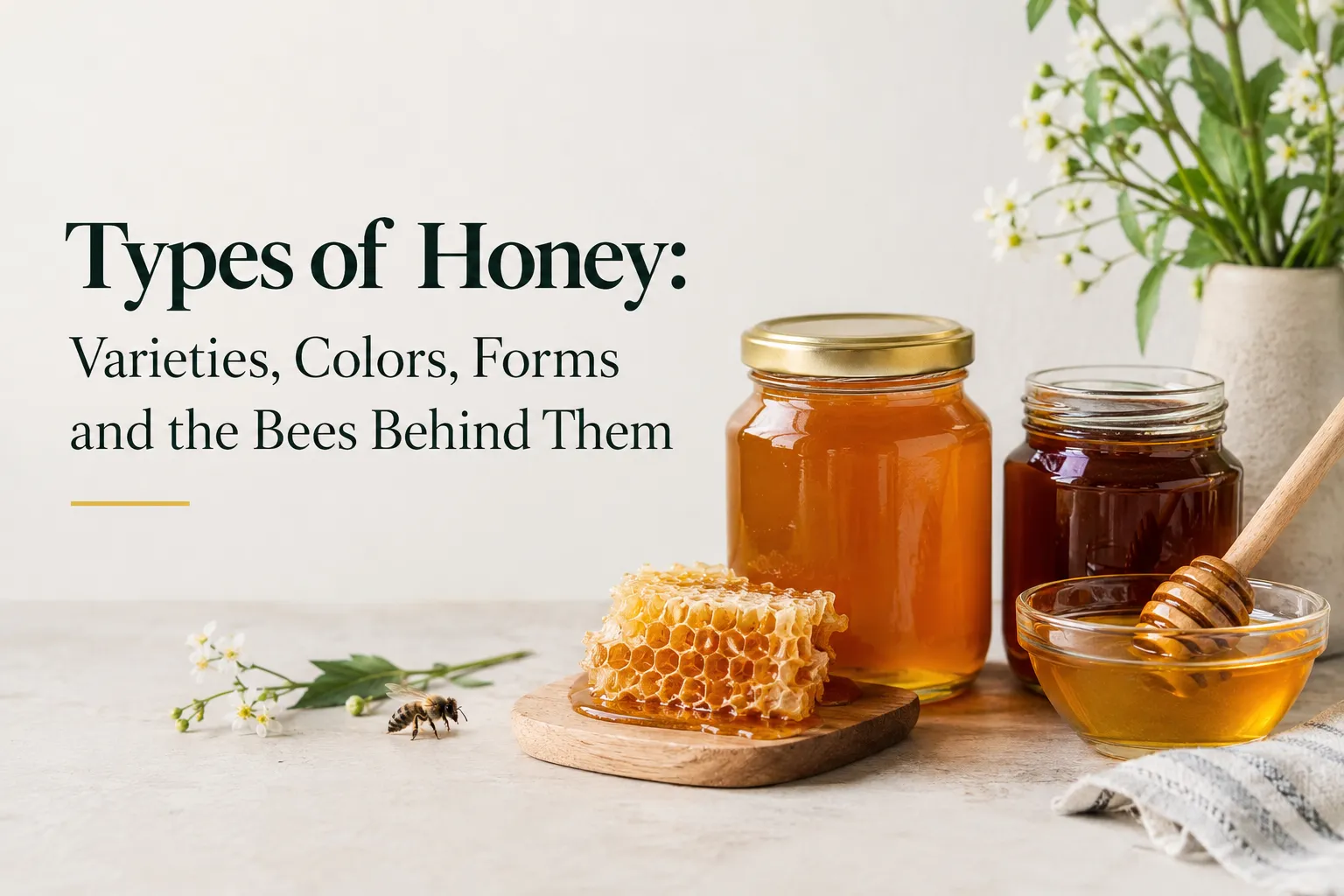
There are four ways to sort the types of honey: by the flower the bees visited, by color, by form such as raw or creamed, and by the species of
Honey benefits for men are real but modest. The best human evidence shows that honey can lower fasting blood sugar and cholesterol when it replaces other sugar, and that it