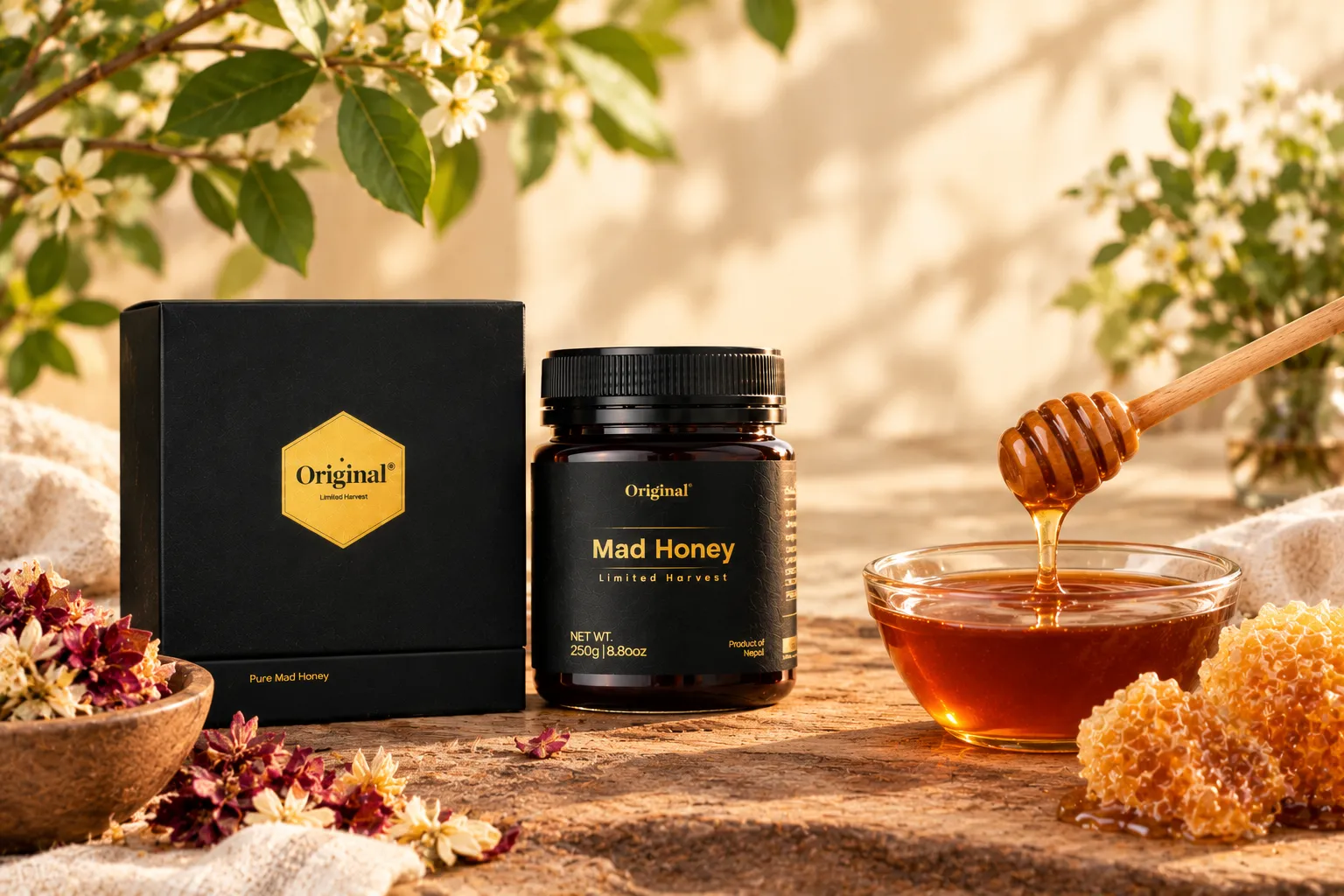

Yes, dogs can have honey, but only in small amounts, only now and then, and only when it is plain honey given to a healthy adult dog. The American Kennel Club says honey is safe for dogs in small quantities, and PetMD describes it as nontoxic but high in sugar and calories, so it should stay an occasional treat. One kind of honey is never safe: mad honey, including Himalayan mad honey. It can contain grayanotoxins, natural toxins that interfere with nerves and the heart, and no safe dose for dogs has been established.
This guide answers the two questions owners search most, can dogs eat honey and is honey safe for dogs, in plain language. You will find what honey for dogs can and cannot do, a serving size table by weight, the dogs that should skip it, a separate section on mad honey, a short safety checklist and five FAQs.
Honey and Dogs at a Glance
- Regular honey: fine in tiny amounts for healthy adult dogs, as an occasional treat.
- Mad honey: never. There is no known safe amount for a dog.
- Puppies under one year: skip raw honey for sure, and the simplest choice is to skip honey altogether.
- Diabetic, overweight or immunocompromised dogs: skip honey unless your vet says otherwise.
- Typical portion: from 1/8 teaspoon for a tiny dog to 1 tablespoon for a giant breed, once or twice a week at most.
Is Honey Safe for Dogs? What Vets and Pet Health Sources Say
Honey is not poisonous to dogs. PetMD states plainly that honey is not toxic to dogs, though too much can push blood sugar up and add weight. The real questions are which honey, how much, and which dog.
That third question matters more than people expect. A Labrador in good shape and a diabetic terrier can react to the same teaspoon in very different ways. Every mainstream source agrees on the same core advice: check with your veterinarian before adding any new human food, especially if your dog has a health condition.
Honey is not toxic, but it is not free
Honey is mostly sugar. A teaspoon has roughly 21 calories and about 6 grams of sugar, which sounds small until you compare it to a small dog’s daily needs. A 5 kg dog eats somewhere around 350 calories a day, so one teaspoon is close to 6 percent of the whole day’s food. PetMD advises that treats of every kind should make up no more than 10 percent of daily calories. Honey uses up that allowance quickly.
What is actually in honey
Beyond sugar and water, honey carries tiny amounts of vitamins, minerals, enzymes and plant compounds. PetMD lists ascorbic acid, niacin, riboflavin, calcium, copper, iron, magnesium and several other nutrients. The amounts in a dog sized serving are minuscule, though. Honey is not a way to fill nutritional gaps. A complete, balanced dog food does that job.
Honey for Dogs: Possible Benefits and What the Evidence Really Shows
People give honey to dogs for a long list of reasons. Some have a reasonable basis and some rest on stories. The AKC points out that few conclusive studies back up the health claims about honey, so many of them remain anecdotal. Here is where things stand.
Antioxidants and trace nutrients
Honey contains antioxidants, and PetMD notes they help protect body cells from damage. That is true in a lab sense. In a real dog eating an eighth of a teaspoon once a week, the effect is too small to notice. Think of it as a bonus of a treat, not a reason to feed one.
Wound and skin care
Manuka honey gets the most attention here. PetMD explains that manuka honey has more antimicrobial compounds than other types and can support wound care by inhibiting bacterial growth. Vets do use honey based dressings in some cases, but that is a controlled clinical setup. Smearing kitchen honey on an open wound at home is a poor idea, because your dog will lick it off and deep or infected wounds need proper care. Ask your vet before treating any wound yourself.
Cough and sore throat
Honey soothes a scratchy throat in people, so it is natural to wonder about dogs. PetMD says it is not clear that honey helps a dog’s cough the way it helps ours, and it recommends calling your vet first because many conditions cause coughing and some are serious. A persistent cough in a dog can point to kennel cough, heart trouble or airway problems, and a spoonful of honey can delay the exam that matters.
Seasonal allergies
The popular idea is that local honey contains small amounts of pollen and so builds tolerance. The AKC calls this one of the most common claims about honey and notes that the scientific evidence is lacking. There is also a practical mismatch: many dog allergy triggers are wind carried grass, tree and weed pollens, while honey mostly reflects flowers that bees visit. If your dog scratches and licks seasonally, a vet visit will do far more than honey.
A useful motivator
Honey works well as a small, sticky reward. A thin smear on a lick mat can help during nail trims or vet prep. That is a genuine use, as long as it stays tiny.
Risks of Giving Honey to Dogs
Sugar, weight gain and teeth
Too much sugar can cause an upset stomach with vomiting, diarrhea, constipation or low energy, and over time it can contribute to obesity and raise diabetes risk. Honey is also sticky, so it clings to teeth. Petco suggests brushing your dog’s teeth after a small amount of honey to help protect against gum disease.
Botulism spores in raw honey
Raw honey can carry spores of Clostridium botulinum. PetMD recommends avoiding raw honey for puppies under one year and for dogs with weakened immune systems, such as those on chemotherapy. The same reason explains why human babies should not eat honey: Poison Control notes that children under 12 months are at risk of infant botulism from honey or foods containing it.
For a healthy adult dog the risk is low. For a puppy or a dog with a suppressed immune system it is a risk with no upside worth taking. Petco lists weakness, paralysis of the hind legs and unresponsiveness as signs of botulism in dogs, and says to see a vet right away if you suspect it.
Allergic reactions
True honey allergy is rare in dogs, but it happens. A dog that has had a bad reaction to bee stings should not get honey. Watch for itching, hives, swelling around the face, vomiting or trouble breathing. Facial swelling and breathing trouble are emergencies.
Hidden ingredients in “honey” products
Plain honey is one thing. Honey mixed into other products is another, and this is where many real accidents start.
- Xylitol: Pure honey does not contain it, but some sugar free spreads, nut butters, syrups and lozenges do. The FDA says xylitol poisoning in dogs can bring vomiting, weakness, staggering, collapse and seizures as blood sugar drops. The Merck Veterinary Manual adds that dogs are the only domestic species in which xylitol toxicity has been reported.
- Garlic or onion infused honey: Both are harmful to dogs.
- Honey roasted nuts: Macadamia nuts can make dogs sick.
- Chocolate, raisins or spiced coatings: Honey glazed snacks often carry other ingredients that are dangerous on their own.
Always read the whole ingredient list. If the label says anything other than honey, treat it as a different product.
Honeycomb
Small chunks of honeycomb are sometimes offered as a treat. The wax is hard to digest, and a big piece can upset the stomach or, in a small dog, cause a blockage. Skipping comb is the easy call.
Which Types of Honey Can Dogs Have?
Pasteurized honey is the sensible default for most households. Petco’s advice is that when in doubt, choose pasteurized honey and check with your veterinarian.
Raw honey is acceptable for healthy adult dogs in small amounts according to major pet health sources, with the puppy and weak immune system exceptions covered above.
Manuka honey is mostly relevant for topical use under veterinary guidance. It costs more, and as a treat it offers no proven edge over ordinary honey.
Local honey is fine under the same rules as any other honey. Its allergy benefit is unproven.
Flavored or infused honey deserves a label check every time.
Mad honey is not in the same category at all, and it gets its own section below.
How Much Honey Can a Dog Have? Serving Size Table
PetMD sets maximum honey portions by dog size, meant for no more than once or twice a week. The table below follows those limits and adds metric weights, volume and approximate calories for readers who measure differently.
| Dog size | Weight | Maximum serving | Approx. volume | Approx. calories |
| Extra small | 2 to 10 lb (1 to 4.5 kg) | 1/8 teaspoon | 0.6 ml | 3 |
| Small | 11 to 20 lb (5 to 9 kg) | 1/4 teaspoon | 1.25 ml | 5 |
| Medium | 21 to 50 lb (10 to 23 kg) | 1/2 to 1 teaspoon | 2.5 to 5 ml | 10 to 21 |
| Large | 51 to 90 lb (23 to 41 kg) | 2 teaspoons | 10 ml | 42 |
| Extra large | 91 lb and up (41 kg and up) | 1 tablespoon | 15 ml | 64 |
Treat these as ceilings, not targets. Most dogs will enjoy a lick of honey just as much at a quarter of the listed amount. Puppies under one year get none. Dogs with a health condition follow whatever amount their vet gives them, which may be zero.
How to introduce honey
- Start with a fraction of the table amount, such as a small lick.
- Wait a full day and watch for loose stool, vomiting, itching or unusual tiredness.
- If everything looks normal, keep honey to an occasional treat and count it inside the 10 percent treat limit.
- Do not give honey on the same day as other sugary extras.
Safe Ways to Serve Honey to Your Dog
Keep it simple. The fewer ingredients, the fewer surprises.
- Lick mat smear: a thin layer, well under the table amount.
- Plain yogurt topper: mix a small drop into unsweetened yogurt with no artificial sweeteners. Skip dairy if your dog is lactose intolerant.
- Frozen chew toy: PetMD suggests stirring a little honey into peanut butter without xylitol, stuffing it into a toy and freezing it. Check the peanut butter label first.
- Homemade baked treats: honey is a safe ingredient when the rest of the recipe is dog safe and the per treat amount stays tiny.
Use a clean spoon, do not pour from the jar, and put it away right after.
Which Dogs Should Avoid Honey?
Some dogs should skip it entirely. If your dog fits any item below, the answer to “can dogs have honey” for that dog is no, unless a vet tells you otherwise.
- Puppies under one year: their immune and digestive systems are still developing, which is the concern behind the botulism warning.
- Diabetic dogs: the AKC says honey should not be given to diabetic dogs.
- Overweight or obese dogs: honey adds calories with no nutritional payoff, and the AKC notes the sugar can lead to obesity.
- Dogs with weakened immune systems: for example dogs on chemotherapy or long courses of immune suppressing drugs.
- Dogs with bee or honey allergies: a past reaction to stings is reason enough to avoid it.
- Dogs with dental disease: sticky sugar makes existing mouth problems worse.
- Dogs on prescription diets: PetMD says dogs on prescription diets should not eat treats outside the diet unless the vet approves.
- Any dog with an ongoing health condition: the AKC advises talking to your vet about how much honey, if any, is okay.
Mad Honey and Dogs: Why It Should Never Be Given
Warning: Everything above is about regular honey. Mad honey plays by different rules, and the rule is simple: never give it to a dog, in any amount, for any reason.
What is mad honey?
Mad honey is made when bees collect nectar from rhododendron and related plants that produce grayanotoxins. It comes from regions including Nepal and the Black Sea area of Turkey. Himalayan mad honey from Nepal is the version most people know from online stores. Original Mad Honey sells it for adult customers, and readers who want the background on the honey itself can start with the mad honey page.
Why grayanotoxins are a problem
Grayanotoxins act on the sodium channels that nerves and heart cells use to fire. They keep those channels switched on, which is why symptoms center on dizziness, nausea, low blood pressure and a slowed heart.
Human case reports show how quickly this can turn serious. In one report, a 75 year old man arrived at an emergency room an hour after eating 20 to 30 mL of raw wild honey, with a heart rate of 45 and blood pressure of 65/41. In another, a man developed dizziness, nausea and cold sweats within half an hour of eating a tablespoon of mad honey and needed hospital treatment. Most patients recover with fluids, monitoring and a medicine called atropine, and University of Utah Poison Control notes that outcomes are generally good and no deaths were recorded in modern times. Still, rare life threatening complications such as cardiac arrest and heart attack have been reported.
Now put a dog in that picture. A tablespoon that sent an adult human to the emergency room is a far larger dose per kilogram for a 10 kg dog. That is reasoning from body weight, not a measured dog dose, and it points in only one direction.
What is known about grayanotoxin and dogs
The honest answer is that direct research on dogs eating mad honey is almost nonexistent. What does exist is consistent:
- The ASPCA lists azalea and rhododendron as toxic to dogs, cats and horses because of grayanotoxin, with vomiting, diarrhea, weakness and cardiac failure among the clinical signs.
- A 2026 systematic review found only 11 companion animal cases among 122 animals poisoned by grayanotoxin plants, and noted that effects on animal health have been scarcely studied. The authors describe grayanotoxins as an emerging food safety risk of veterinary importance.
- An earlier review observed that while poisoning is rarely lethal in humans, that is not the case for cattle and pet poisoning cases.
Missing data is not reassurance. It means nobody can hand you a dose for your dog. Potency adds another unknown: some rhododendron species carry more grayanotoxin than others, and you cannot judge the strength of a jar by taste or color.
Warning signs in a dog
Watch for drooling, vomiting, diarrhea, weakness, wobbling or stumbling, tremors, a slow or irregular heartbeat, and collapse. Veterinary literature on grayanotoxin in animals describes vomiting, depression, salivation, muscle tremor, convulsions, heart rhythm changes and weakness. In people, symptoms appeared within an hour or so of eating the honey (see the case reports above), so do not wait for signs before you call.
What to do if your dog eats mad honey
- Call your vet or the nearest emergency clinic immediately, even if the dog looks fine.
- In the US, the ASPCA Poison Control line is (888) 426-4435, and a consultation fee may apply. Elsewhere, use your local animal poison service.
- Keep the jar or label and note the time, the amount and your dog’s weight.
- Do not try to make your dog vomit unless a veterinarian tells you to.
- Take the jar with you to the clinic.
Regular honey vs mad honey for dogs
| Regular honey | Mad honey | |
| Safe for dogs? | Yes, in small amounts for healthy adults | No, never |
| Main concern | Sugar, calories, botulism spores in raw honey | Grayanotoxins acting on nerves and heart |
| Serving guideline | Tiny portions by weight, once or twice a week | None. No safe dose is known |
| Puppies | Skip | Never |
| If eaten by accident | Watch for stomach upset | Call a vet right away |
Keeping mad honey away from pets
If you buy mad honey for your own use, store it like a medicine. Put it in a closed cabinet above dog height, keep the lid tight, wipe up drips and do not leave a used spoon or plate where a dog can reach it. Dogs will lick sticky packaging and empty jars, so bin those out of reach as well.
Any dosage information about mad honey, including what appears on the mad honey dosage page, is written for adult humans. None of it converts to a pet. The same goes for testing: Original Mad Honey shares a lab report, and reading a lab report is a good habit for any buyer, but a lab report describes a batch for human buyers. It does not make a jar safe for a dog. Adults with heart conditions, low blood pressure or regular medication should talk to their doctor before trying mad honey at all.
Safer Alternatives to Honey Treats
If you want a low sugar reward, pick something with less baggage. The AKC suggests cucumbers as a lower sugar option. Carrot sticks, green beans, blueberries, apple slices without the core and seeds, and small pieces of cantaloupe are also popular choices, given in moderation. For a sticky lick mat, plain pumpkin puree with no added sugar or spices works well.
Safety Checklist Before You Give Honey to Your Dog
- My dog is a healthy adult, not a puppy under one year.
- My dog is not diabetic, overweight, immunocompromised or allergic to bee products.
- My vet has not put my dog on a restricted or prescription diet.
- The jar contains only honey, with no added sweeteners, garlic, onion, chocolate or nuts.
- It is regular honey, and I am completely sure it is not mad honey.
- I measured the portion from the table above and started with less.
- I will count honey inside the 10 percent treat limit and give it once or twice a week at most.
- I will watch my dog for 24 hours after the first taste.
- The jar goes back into a closed cabinet, out of reach.
Frequently Asked Questions
Can dogs have honey every day?
No. PetMD recommends the listed portions no more than once or twice a week. Daily honey adds sugar and calories that most dogs do not need, and the cost shows up as weight gain and dental trouble over time.
Can puppies eat honey?
The safest answer is no. Raw honey may carry botulism spores, and PetMD advises against raw honey for puppies under one year because their immune systems are not fully developed. Puppies need complete puppy food, and honey adds nothing they need.
Is raw honey or pasteurized honey better for dogs?
For healthy adult dogs, both are acceptable in small amounts. Pasteurized honey is the more cautious choice, especially in homes with an older, sick or very young dog. Raw honey is off the table for puppies and dogs with weakened immune systems.
Can dogs have mad honey or Himalayan mad honey?
No. Mad honey can contain grayanotoxins that affect the heart and nerves, and no safe amount is known for dogs. Store it out of reach, and call a vet or animal poison line at once if your dog eats any.
What should I do if my dog ate a lot of regular honey?
Expect a sugar upset, usually vomiting, diarrhea or lethargy, and call your vet for guidance based on your dog’s size and health. Check the label for xylitol or other additives before you call, and mention it. Dogs with diabetes need a vet’s advice straight away.
Before You Reach for the Jar
For a healthy adult dog, a small taste of plain honey is a harmless treat. Keep it tiny, keep it rare, and let your vet weigh in if your dog has any health condition. Mad honey is a different story and stays completely away from pets. If you are an adult who wants to learn more about it for yourself, you can browse the Original Mad Honey shop and read the dosage and lab report pages first. Your dog gets the regular honey, and only a little.
This article is for general information and does not replace advice from your veterinarian.
References and Further Reading
- American Kennel Club, Can Dogs Eat Honey?
- PetMD, Can Dogs Eat Honey?
- Petco, Can Dogs Eat Honey? What Pet Parents Should Know
- ASPCA, Toxic and Non-toxic Plants: Rhododendron and Azalea
- Grayanotoxin poisoning in animals following the ingestion of Ericaceae plants (systematic review, 2026), PubMed
- Grayanotoxin Poisoning: “Mad Honey Disease” and Beyond (review, 2012), Springer
- Mad Honey Poisoning Caused by Grayanotoxin Toxicity in a 75 Year Old Male Patient (case report, 2026), PubMed
- University of Utah Poison Control, Case Files: Mad Honey
- Poison Control, Botulism and honey: What’s the connection?
- U.S. FDA, Paws Off Xylitol; It’s Dangerous for Dogs
- Merck Veterinary Manual, Xylitol Toxicosis in Dogs