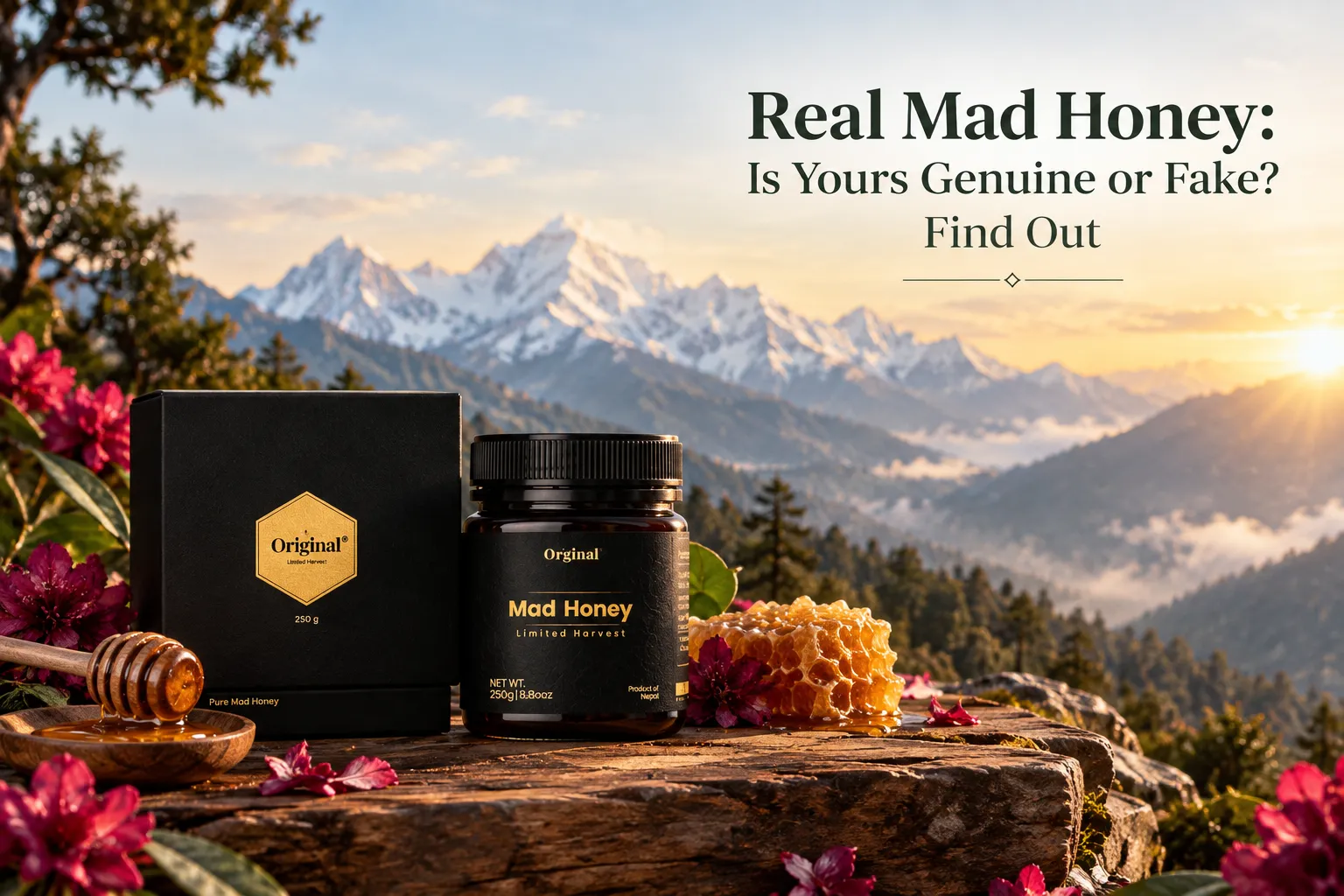
The phrase real mad honey shows up in almost every search about this product, and for good reason. Because mad honey is rare, seasonal, and expensive to harvest properly, the market has filled up with diluted, mislabeled, and sometimes completely fake versions sold under the same name. Knowing what makes mad honey real, rather than just marketed that way, is the difference between getting a genuine, potent jar and getting a bottle of ordinary honey with a dramatic label.
This guide explains exactly what real mad honey is, how it is made, and how to confirm you are buying the authentic version.
Real Mad Honey At a Glance
| Question | Quick Answer |
|---|---|
| Is mad honey a real substance? | Yes, it is a genuine type of honey containing grayanotoxins, produced mainly in Nepal and Turkey |
| What makes it different from regular honey? | Bees forage almost exclusively on rhododendron flowers, which contain grayanotoxin, a compound not found in ordinary honey |
| How can you tell if it’s real? | Dark reddish brown color, thick texture, a bitter tannic aftertaste, and lab documented grayanotoxin levels |
| Where does real mad honey come from? | Nepal’s Himalayan cliffs and Turkey’s Black Sea region |
| Is it safe? | In small, controlled amounts it is traditionally considered safe for healthy adults, though large doses can cause poisoning |
| How much should a first time user take? | About one quarter to half a teaspoon, waiting at least 45 to 60 minutes before considering more |
What Makes Mad Honey “Real”?
Real mad honey is not a separate species of honey or a manufactured product. It is genuine honey that happens to contain grayanotoxins, a group of natural compounds found in rhododendron flowers. According to Wikipedia’s summary of the topic, mad honey is dark, reddish honey produced from the nectar and pollen of the rhododendron genus, and it carries moderately toxic and narcotic effects because of that grayanotoxin content (Wikipedia, Mad Honey).
Most commercial honey is made from a wide mix of flowers, so any trace amounts of grayanotoxin get diluted to the point of having no effect. Real mad honey only exists because bees in specific high altitude regions forage almost exclusively on rhododendron blooms for a short seasonal window, which concentrates the compound enough to produce measurable effects in the body. That narrow, specific sourcing is exactly what separates real mad honey from ordinary honey, and it is also why genuine mad honey can never be a year round, mass produced product.
For a deeper look at the plant behind the effect, see our rhododendron flowers guide, and for the full background on the honey itself, our mad honey page covers the science in more detail.
How to Tell Real Mad Honey From Fake
Because the term gets used loosely by sellers, here is what genuinely separates real mad honey from a diluted or fake product.
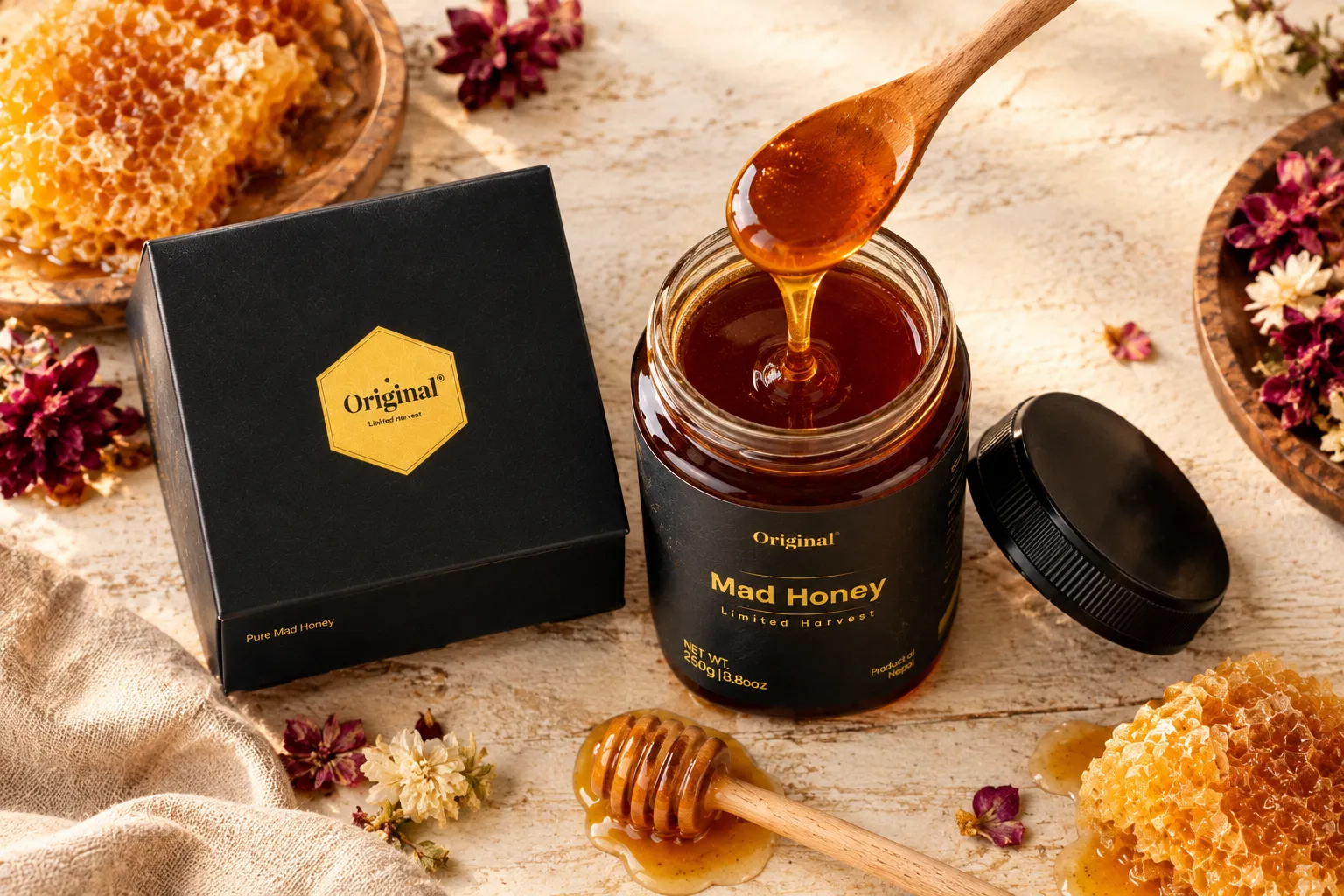
Color and Texture Real mad honey is thick and ranges from a deep reddish amber to dark brown. Honey that pours thin and easily, or looks pale and golden like a typical supermarket jar, is unlikely to be genuine mad honey.
Taste This is one of the clearest tells. Real mad honey is sweet at first, but it carries a distinct bitter, tannic finish that lingers at the back of the throat, along with a mild warmth that builds slowly after swallowing. A honey that tastes exactly like ordinary honey with no unusual aftertaste has little or no grayanotoxin content, regardless of how it is labeled.
Lab Documentation Genuine sellers test each batch for grayanotoxin concentration and make that information available to buyers. If a seller cannot show any testing behind their “real mad honey” claim, that claim should be treated with caution.
Harvest Season Authentic mad honey is only collected during specific rhododendron blooming windows, typically spring and autumn. A seller advertising constant, year round availability is describing something inconsistent with how real mad honey is actually produced.
Origin Transparency Real mad honey traces back to one of two regions, Nepal’s Himalayan cliffs or Turkey’s Black Sea provinces. Vague or unnamed sourcing is a warning sign.
Where Real Mad Honey Actually Comes From
Nepal In Nepal, real mad honey is harvested by the Gurung people, using a centuries old cliff hunting tradition. Honey hunters descend sheer rock faces on handmade rope and bamboo ladders to reach wild combs built by Apis laboriosa, the largest honey bee species in the world. These bees forage on wild rhododendron blooms found above 2,500 metres, which is part of why Himalayan mad honey is generally considered the strongest version available. You can read the full story on our Gurung honey hunters page and see exactly where our own harvest comes from on our mad honey origin page.
Turkey In Turkey, real mad honey is known locally as deli bal, produced in the Black Sea provinces of Rize and Trabzon from managed hives placed near Rhododendron ponticum and Rhododendron luteum. Turkish deli bal tends to be milder and lighter in flavor than the Himalayan version.
The Growing Market for “Real Mad Honey” Sellers
As demand has grown, several brands have built their entire identity around proving authenticity, some even using the phrase directly in their name, such as Real Mad Honey, a specialty online store selling honey sourced from Nepal and Turkey. Other established sellers, including Best Mad Honey, Medicinal Mad Honey, and Maddest Mad Honey, all make similar claims about wild Himalayan sourcing and lab verified grayanotoxin content.
This is generally a good sign for buyers, since it means transparency has become a competitive advantage in this market rather than an afterthought. That said, the word real in a brand name is not proof by itself. The same verification steps outlined above, color, taste, batch specific lab data, and harvest season, apply no matter whose name is on the jar. Original Mad Honey publishes its own lab reports for exactly this reason, so buyers do not have to take authenticity claims on faith.
Original Mad Honey vs Real Mad Honey: A Closer Look
Since Real Mad Honey is one of the most recognized names built specifically around the authenticity question, it is worth comparing it directly against Original Mad Honey.
| Category | Original Mad Honey | Real Mad Honey |
|---|---|---|
| Origin | Nepal, Annapurna range (Lamjung) | Nepal, plus Turkey through separate partners |
| Bee species | Apis laboriosa, wild cliff hives | Apis laboriosa, wild cliff hives |
| Lab testing | Published lab reports per batch | Published batch level GTX reports |
| Entry price | $119 for 250g | Around $42.50 for a 50g jar, scaling up with bundles |
| Larger size pricing | $199 for 500g | Around $212 to $425 for 250g to 500g depending on bundle deals |
| Guarantee | 30 day promise | 60 day satisfaction guarantee |
| Shipping | 180+ countries, ships from Nepal and regional hubs | Ships from a US warehouse in Texas and a Netherlands warehouse for other countries |
| Traceability | Batch number, harvest date, QR verification | Batch level lab reports, documentary style sourcing content |
Where They Are Similar Both brands source from wild Himalayan cliff hives harvested by hand, both publish batch level grayanotoxin testing, and both center their entire marketing around proving authenticity rather than just claiming it. Neither can reasonably be called fake or diluted based on what each publishes.
Where They Differ Real Mad Honey ships from US and European warehouses, which generally means faster delivery for buyers in North America and Europe, and it backs orders with a longer 60 day guarantee. Its pricing per gram is also noticeably higher at smaller sizes, since its smallest jar is a 50g size positioned as an entry product rather than a full sized jar.
Original Mad Honey focuses on shipping the actual Himalayan harvest more directly, keeps its sizing simpler with two straightforward jars, and prices its 250g and 500g jars lower per gram than Real Mad Honey’s comparable bundle pricing. Its 30 day guarantee is shorter, which is worth factoring in if a longer return window matters to you.
The Bottom Line If fast US or EU based shipping and a longer 60 day return window matter most, Real Mad Honey’s setup is built for that. If you want a more direct, lower cost per gram jar of Himalayan mad honey with straightforward batch verification, Original Mad Honey is the simpler choice. Either way, checking the specific batch lab report before buying remains the most reliable step, regardless of which brand you choose.
The Science Behind Why It Is Called “Mad”
The compound responsible for mad honey’s effects, grayanotoxin, interacts with sodium channels in nerve and cardiac cells. In small amounts, this produces the sensations people describe as a light buzz, muscle relaxation, and a warm, calm feeling. In large amounts, it can cause a slowed heart rate, low blood pressure, dizziness, nausea, and in severe cases, loss of consciousness.
A peer reviewed review published on the National Institutes of Health’s PMC database confirms that mad honey poisoning cases are documented mainly in Turkey, Korea, and Nepal, and that grayanotoxins come from several rhododendron species including R. luteum, R. ponticum, and R. simsii (pmc.ncbi.nlm.nih.gov, PMC9080652). A separate historical account published by Reuters describes documented poisoning cases in Turkey linked to men using mad honey as a traditional stimulant, underscoring why dosage control matters even with a genuine, real product (Reuters, 2015). Despite the word mad in its name, the effect is closer to intoxication than actual danger when the honey is consumed in the small, traditional amounts it was always meant to be taken in.
How to Buy Real Mad Honey Safely
Before ordering from any seller, it helps to know exactly what you are checking for. Our buy mad honey guide walks through this in detail, but the short version is:
- Confirm the honey is lab tested for grayanotoxin concentration, ideally per batch rather than as a general brand claim.
- Check that the harvest season and origin, Nepal or Turkey, are clearly stated.
- Look for a bitter, tannic aftertaste and a thick, dark texture once you receive it.
- Start with a small dose, about one quarter to half a teaspoon, and wait at least 45 to 60 minutes before considering more.
- Avoid it entirely if you are pregnant, breastfeeding, under 18, or managing a heart or blood pressure condition. Our mad honey and blood pressure guide covers this in more depth.
If you want to see a real, lab documented Himalayan harvest for yourself, our shop offers batch traceable jars in 250g and 500g sizes, sourced directly from Gurung cliff hunters in Nepal’s Annapurna range.
Frequently Asked Questions
Is mad honey actually real, or is it just marketing?
It is genuinely real. Mad honey is a documented type of honey containing grayanotoxins, produced when bees forage heavily on rhododendron flowers. It has a long recorded history of both traditional use and occasional poisoning cases in Nepal, Turkey, and Korea.
How do I know if the mad honey I bought is real?
Check its color, which should be a deep reddish brown, its taste, which should carry a bitter, tannic finish rather than tasting like ordinary honey, and ask the seller for batch specific lab results showing grayanotoxin concentration.
Can real mad honey expire or lose potency?
Like most raw honey, mad honey has a long shelf life when stored properly, though grayanotoxin concentration is set at harvest and does not increase over time. Proper storage away from heat and moisture helps preserve both flavor and potency.
Is real mad honey legal to buy?
Yes, in most countries, including the United States and the United Kingdom, mad honey is legal to purchase and consume as a food product.
Where can I buy real, lab tested mad honey?
Look for sellers who publish batch specific grayanotoxin data and clearly state their harvest origin. Our Original Mad Honey shop sources directly from Gurung cliff hunters in Nepal and lab tests every batch before it ships.
Conclusion
Real mad honey is a genuine, well documented product with thousands of years of history behind it, but the market around it has made authenticity something buyers need to actively verify rather than assume. Color, taste, harvest season, and lab documentation remain the most reliable ways to separate the real thing from an ordinary jar riding on a trending name. Once you know what to look for, finding an authentic, responsibly harvested batch becomes far easier.
References
- Mad honey. Wikipedia. https://en.wikipedia.org/wiki/Mad_honey
- Mad honey poisoning: a comprehensive review. PMC, National Center for Biotechnology Information. https://pmc.ncbi.nlm.nih.gov/articles/PMC9080652
- Study: ‘Mad’ Honey Sex Stimulant Sending Men to ER With Food Poisoning. Reuters, via Fox News, 2015. https://www.foxnews.com/story/study-mad-honey-sex-stimulant-sending-men-to-er-with-food-poisoning.print