

How Long Does Honey Last? Shelf Life, Storage Tips, and Signs of Spoilage
Honey that is sealed, dry and clean can last for years, and well kept pure honey can stay usable long after the date printed on the jar. That is the
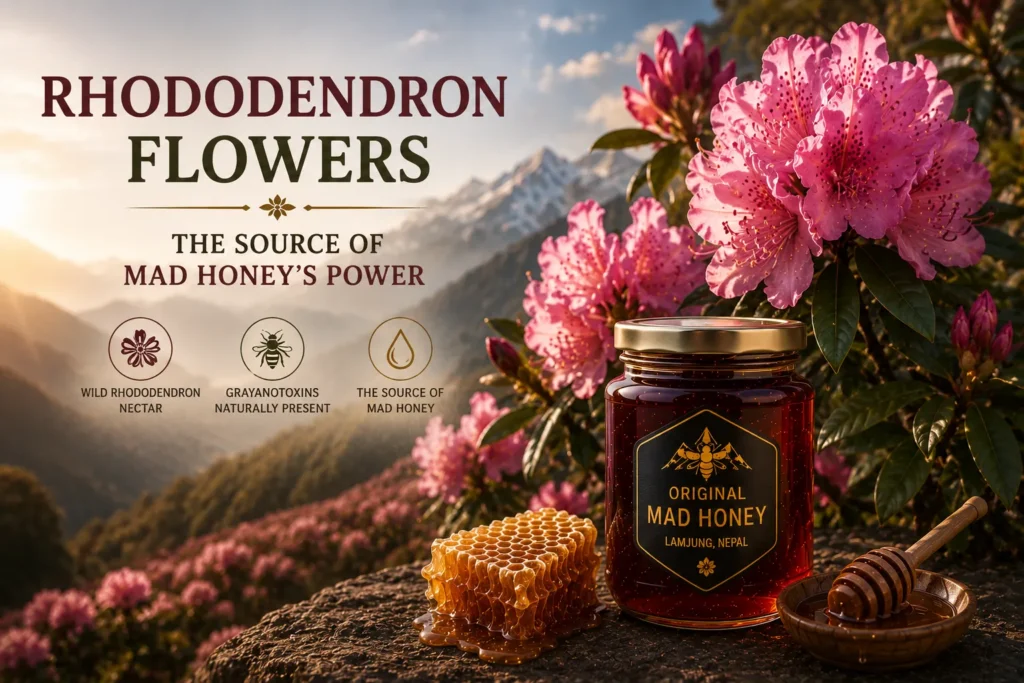
The rhododendron flower is the bell shaped bloom of shrubs and trees in the genus Rhododendron, a group that also includes azaleas. Most rhododendrons flower from spring to early summer, although some garden types open as early as late winter and others bloom into late summer. The flower means beauty in Nepal, where it is the national flower, and it meant “danger” in the Victorian language of flowers, because the plant is toxic. A few rhododendron species also act as the mad honey plant: bees feed on their nectar, and the honey carries grayanotoxins.
We sell mad honey from Nepal, so we have a commercial interest in the honey side of this topic. This guide covers the flower first, then the honey, and it points out where the two meet.
A rhododendron flower is the bloom of a plant in the genus Rhododendron, which belongs to the heather family (Ericaceae). A 2024 study of Nepal’s national flower notes that the genus holds more than 1,000 species worldwide, and Nepal alone has around thirty. The word comes from Greek: rhodon means rose and dendron means tree, so the name translates to “rose tree.”
Rhododendron flowers grow in many colors, including red, pink, white, purple, orange, and yellow. Virginia gardeners point out two shape differences that help identify the plants. Rhododendron flowers tend to be bell shaped and grow in round clusters at the ends of branches, while azalea flowers are tubular or funnel shaped, and each stem carries one flower.
| Feature | Rhododendron | Azalea |
|---|---|---|
| Genus | Rhododendron | Rhododendron (azaleas are a part of it) |
| Flower shape | Bell shaped, in round clusters | Tubular or funnel shaped, one flower per stem |
| Usual bloom start | Later in spring | From April |
| Leaves | Often evergreen and leathery | Evergreen or deciduous |
Because botanists place azaleas inside the same genus, every azalea is a rhododendron. A flower rhododendron fan might use either word for the same garden shrub.
Most rhododendrons flower in spring or early summer. Garden guides give a wider window, though: depending on the species, the variety, and the climate, rhododendrons bloom any time from late winter to late summer. In mild coastal climates the season can stretch to about seven months, and in cold climates it can shrink to about three.
The table below shows when different groups bloom.
| Group | Typical bloom time |
|---|---|
| Very early garden varieties | December to February in mild climates, and April in cooler ones |
| Deciduous North American azaleas | April into early June |
| Evergreen azaleas | From April, with late types such as Satsuki azaleas in late May and June |
| Mid season garden rhododendrons | Mid to late May |
| Late varieties and Rhododendron maximum | June and July |
| Himalayan rhododendrons in Nepal | March to May, with peak bloom in late March to mid April at mid elevations |
When does a rhododendron flower in Nepal? Travel and botanical sources agree that Rhododendron arboreum, called lali gurans, blooms from about mid March to late April across the middle hills, and that higher slopes bloom later, in mid to late April. A warm winter can pull the bloom earlier.
A few facts help you predict your own plants:
The bloom matters for honey too. Bees make mad honey from the nectar of toxic rhododendron species, and Wikipedia notes that the red honey linked to the intoxicating effect comes from spring bloom at high altitude. The mad honey harvest therefore follows the flowering season, and a poor bloom can mean very little honey.
The rhododendron flower carries two meanings that sit side by side.
Beauty and national pride. In Nepal, Rhododendron arboreum is the national flower, known as lali gurans. People wear the blossoms, and families in some regions turn the petals into juice and pickles each spring. In India, rhododendron is the state tree of Uttarakhand, where people make a squash called burans from the flowers. It is also the state flower of Himachal Pradesh and Nagaland. In the United States, rhododendron is the state flower of West Virginia and Washington, and Jiangxi province in China also claims it as its flower.
Caution and danger. In the Victorian language of flowers, the rhododendron meant danger and warning. A Smithsonian Gardens teaching guide lists Rhododendron albiflorum under “danger, flee,” and floriography writers describe the flower as a message that says “watch your back.” The meaning has a real basis, because the plant contains toxins that harm people and animals.
A modern reading of the flower therefore mixes admiration with respect. The same plant that covers a hillside in red and pink also produces a toxin that can poison.
| Species | Where it grows | Notes |
|---|---|---|
| Rhododendron arboreum | Himalayas, Nepal | Nepal’s national flower, red, pink, or white, blooms March to April |
| Rhododendron campanulatum | Higher Himalayan slopes | State flower of Himachal Pradesh |
| Rhododendron ponticum | Black Sea region, Turkey | Named in clinical reviews as a main mad honey source |
| Rhododendron luteum | Black Sea region, Turkey | Known as the yellow azalea, also a named mad honey source |
| Rhododendron maximum | Appalachian Mountains | State flower of West Virginia, blooms in June and July |
| Rhododendron catawbiense | Appalachian highlands | Purple to lavender flowers that peak in May and June |
Nepal’s species change color with height, according to travel guides: red at lower elevations, then pink, then white at the highest. Nepal’s rhododendrons grow between roughly 1,200 and 3,600 meters.
The mad honey plant is the rhododendron. Specifically, it is a small set of rhododendron species whose nectar and pollen carry grayanotoxins. Wikipedia describes mad honey as dark, reddish honey made from the nectar and pollen of Rhododendron, and it says that nearly every part of a toxic rhododendron contains the molecule, including the leaves, flowers, pollen, and nectar.
The genus is huge, and the toxin is uneven. Many species contain at least a little grayanotoxin, while only a few carry significant levels. A review in Cardiovascular Toxicology also names Pieris, Agarista, and Kalmia as related heather family plants that contain grayanotoxins, although rhododendron nectar is the source behind most honey poisoning.
Where does the nectar become honey? The process takes four steps:
In Nepal, the giant Himalayan cliff bee (Apis laboriosa) feeds on rhododendrons across the mid Himalayan belt, according to a 2026 review of grayanotoxin poisoning in Nepal. That is the source of Himalayan red honey and Himalayan mad honey. Turkey’s Black Sea region produces most of the rest. Botanists and honey researchers name plants that produce mad honey in several regions, and rhododendron leads the list.
Journal papers confirm R. ponticum and R. luteum for Turkey. For Nepal, seller and regional sources name R. arboreum and R. campanulatum, but I could not find a peer reviewed paper that confirms which species matters most, so treat that link as likely and not proven.
If you came from a puzzle, here is the short answer. Crossword solver sites record that the New York Times used the clue “Plant whose nectar produces the mildly toxic ‘mad honey'” on November 15, 2025, and the answer was AZALEA. The same sites record a May 6, 2026 clue, “Bloom whose toxic nectar is one source of ‘mad honey’,” with the same answer.
The wording of the clue changes from puzzle to puzzle. You may see “mad honey plant NYT” in a search, or a clue such as “the plant whose nectar produced mad honey.” Count the squares first:
Both answers fit because azaleas belong to the genus Rhododendron, and Rhododendron luteum goes by the common name yellow azalea. We took these dates from crossword solver websites and not from the Times, so check your own puzzle before you fill in the grid.
Yes, and the flower is no exception. Grayanotoxin appears in the flowers, leaves, pollen, and nectar of toxic species. Grayanotoxins keep sodium channels in nerve cells open, which can slow the heart and lower blood pressure, and the result is dizziness, nausea, vomiting, and in serious cases fainting.
Nepal’s traditions make the topic more complicated. A case report from a hospital in Dolakha, Nepal, notes that people use rhododendron flowers to flavor sweet drinks, eat them with salt and chilies, and add them to fish curries. The same report describes a 58 year old man who ate four fresh white flowers (Rhododendron decorum) during a high altitude visit and developed dizziness, headache, nausea, and vomiting. The authors also note that not all rhododendron species are toxic, and that earlier reports of poisoning involved dried flowers.
What does that mean for you?
No. Color and taste are unreliable, because honey from a toxic bloom can look like ordinary dark honey. Only a lab can confirm the source and the strength. Pollen analysis shows which plants the bees visited, and a grayanotoxin test measures the toxin itself. Our lab report shows how we document and test our honey. [ADD REAL DETAIL: whether your lab report includes pollen analysis, grayanotoxin testing, or both.]
Most rhododendrons flower in spring and early summer. Depending on the species and the climate, bloom can start in late winter and stretch into late summer. Each plant blooms for about three to four weeks.
Nepal’s rhododendrons, including the red lali gurans, bloom from about March to May. Peak bloom usually falls in late March to mid April at mid elevations, and higher slopes bloom later.
The flower stands for beauty and national pride in Nepal, and it meant danger and caution in the Victorian language of flowers. Both meanings come from the plant: it is striking, and it is toxic.
Yes, in toxic species. The flowers, leaves, pollen, and nectar can contain grayanotoxins. A Nepal case report describes poisoning after a man ate four fresh flowers, so avoid eating them.
Yes. Azaleas belong to the genus Rhododendron. Azalea flowers tend to be funnel shaped and bloom from April, while rhododendron flowers tend to be bell shaped and bloom later in spring.
Rhododendron produces mad honey. Bees collect nectar from toxic species, such as Rhododendron ponticum and Rhododendron luteum in Turkey, and the honey carries grayanotoxins.
Recent NYT clues on mad honey had the answer AZALEA, with 6 letters. If your grid has 12 squares, the answer is RHODODENDRON.
No. Many species contain some grayanotoxin, but only a few carry significant levels, and bees need a large bloom to make mad honey.
Yes. Nepal’s national flower is Rhododendron arboreum, called lali gurans. It also appears as the state flower of several places, including West Virginia and Washington.
People in parts of Nepal and India use the flowers in drinks and food, but poisoning has been reported, including after fresh flowers. Do not eat them unless a local expert has identified the species and preparation.
https://www.gardenia.net/guide/choosing-azaleas-and-rhododendrons https://www.piedmontmastergardeners.org/article/whats-so-special-about-azaleas-and-rhododendrons/ https://carpenteroak.co.uk/when-do-rhododendrons-flower/ https://bovees.com/gardening/rhododendrons-and-azaleas/ https://en.wikipedia.org/wiki/North_American_azaleas https://www.seattlejapanesegarden.org/blog/2022/6/28/with-their-elegant-late-may-and-june-flowers-satsuki-evergreen-azaleas-extend-the-blooming-season-of-the-genus-rhododendron https://sciencepulse.blog/rhododendrons-bloom-guide https://www.howspruce.blog/rhododendron-bloom-times-us-guide https://www.nepalhikingteam.com/rhododendron-blossoms-in-nepal https://namesinenglish.com/flowers/national-flower-of-nepal/ https://awesomeholidaysnepal.com/blog/rhododendron-in-nepal/
Honey that is sealed, dry and clean can last for years, and well kept pure honey can stay usable long after the date printed on the jar. That is the
There are four ways to sort the types of honey: by the flower the bees visited, by color, by form such as raw or creamed, and by the species of
Honey benefits for men are real but modest. The best human evidence shows that honey can lower fasting blood sugar and cholesterol when it replaces other sugar, and that it