

How Long Does Honey Last? Shelf Life, Storage Tips, and Signs of Spoilage
Honey that is sealed, dry and clean can last for years, and well kept pure honey can stay usable long after the date printed on the jar. That is the
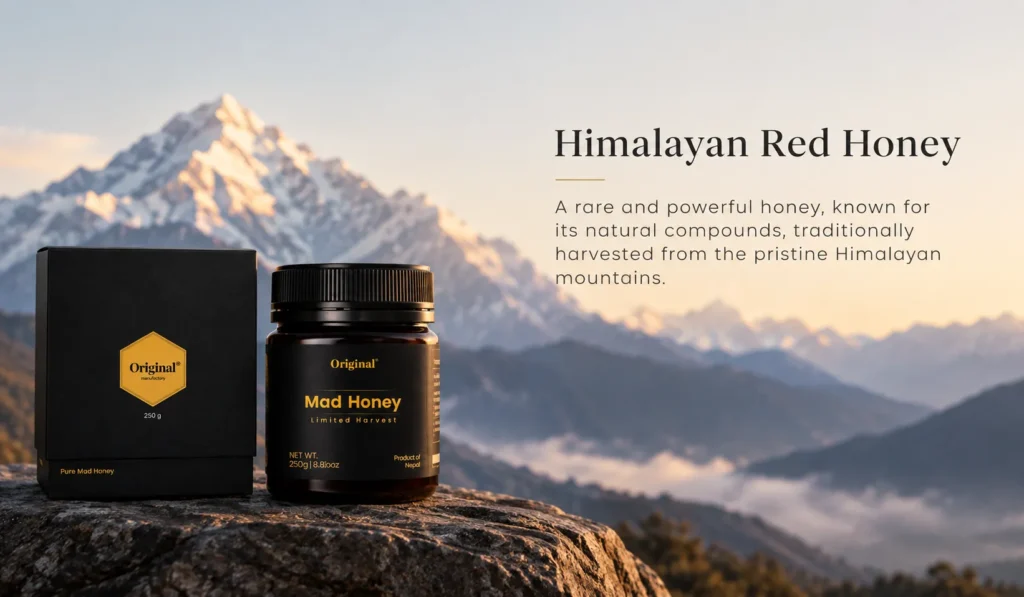
Himalayan red honey is a dark, reddish honey from the mountains of Nepal and the wider Himalayan region. In its best known form, bees make it from rhododendron nectar, and it contains grayanotoxins, the same compounds that make mad honey intoxicating. The name causes confusion, though, because sellers also use “red honey” for products that may contain no grayanotoxin at all.
We sell mad honey from Nepal, so we have a commercial interest in this topic. This guide explains what the name means, what research says about the benefits and risks, and how to check a product before you buy it.
Himalayan red honey is honey that sellers and writers describe as red, harvested in the Himalayas, and often linked to Nepal. The phrase has three common meanings, and they are not the same product.
| Meaning | What it is | Grayanotoxin |
|---|---|---|
| Nepal red honey | Spring honey from Apis laboriosa colonies, made from high altitude rhododendron nectar. People also call it mad honey | Yes, and the strength varies |
| Himalayan cliff honey from other seasons | Honey from the same bee in autumn or from lower altitude flowers | Seller sources say little to none, though no journal paper I found confirms this |
| Red honey from other Himalayan sources | Wild honey that sellers in India describe as red, for example from Himachal forests, with nectar sources such as borage | Not stated, and we could not verify these claims |
Wikipedia’s entry on the bee separates the honey into three kinds: spring or red honey from flowers at higher altitudes, spring honey from mid and lower altitudes, and autumn honey from any site. It states that red honey has an intoxicating effect, which is the link to mad honey. People who ask what is mad honey get the same core answer: honey that carries grayanotoxins. The Nepal version, Himalayan mad honey, is the one most sellers mean when they say red honey.
So what is Himalayan red honey when you see it on a label? Nobody can answer from the name alone. You need the species, the harvest region, the season, and ideally a test result.
The classic red honey comes from a very large bee. Wikipedia describes Apis laboriosa as the world’s largest honey bee, with adults up to about 3 cm long. It nests mostly between 2,500 and 3,000 meters, builds huge combs under cliff overhangs, and forages at altitudes up to about 4,100 meters. A single nest can hold as much as 60 kg of honey.
That setting explains the rarity. Hive bees do not live at those altitudes, so Wikipedia notes that this bee is the only one that produces this honey. Honey hunters climb the cliffs, and the work is dangerous. The Wikipedia entry also says people rarely eat this honey locally, because hunters prefer to sell it, and that the wholesale price of red honey is about five times the price of regular honey from related bees.
The mad honey harvest follows the spring bloom, and a poor season can mean very little honey.
The sources describe the honey as darker and redder than ordinary honey, but I found no peer reviewed study that explains what causes the color. Wikipedia describes mad honey as dark and reddish. Plant pigments, nectar chemistry, and the age of the honey could all play a role, and none of that is proven. That matters for buyers, because it means color alone cannot confirm that a jar is mad honey, and a red tint does not tell you how much grayanotoxin it holds.
Grayanotoxin comes from the plant, not from the bee. Rhododendron species make grayanotoxins and pass them into their nectar and pollen. Bees that work a large rhododendron bloom produce honey that carries the toxins. A review in Cardiovascular Toxicology describes how grayanotoxin keeps sodium channels in nerve cells open, which can slow the heart and lower blood pressure. That is why grayanotoxin is the real marker of mad honey, and why the mad honey plant matters more than the bee.
Two practical points follow:
Himalayan mad honey is honey that contains grayanotoxins and comes from the Himalayan region, mainly Nepal. The word “mad” describes the toxin, not the color. Himalayan red honey is a market name that often means mad honey, but not always. A dark red jar with no grayanotoxin is red honey and not mad honey, and a paler jar with the toxin is mad honey even though it looks ordinary.
| Question | Himalayan red honey | Himalayan mad honey |
|---|---|---|
| What the name means | A market name for dark, reddish Himalayan honey | Honey that contains grayanotoxins |
| Always contains grayanotoxin? | No | Yes |
| Main plant source | Varies | Rhododendron nectar |
| Main region | The Himalayas | Nepal and the wider Himalayan region |
| What proves it | Batch details and a lab report | A grayanotoxin result in a lab report |
| Main risk | Depends on the honey | Dizziness, slow heart rate, low blood pressure |
Himalayan mad honey brings its own legal questions and its own gummy risks, and the safety rules in this guide apply to every jar that contains grayanotoxin. If you buy Himalayan mad honey, treat the batch lab report as the deciding document. It should show the grayanotoxin result for the exact jar you receive.
Himalayan honey means honey from the Himalayan region, and no law or standard defines the term. Among the many types of honey, it covers several very different products, because several bees work the mountains. Wikipedia explains that people use “Himalayan honey bee” informally for any of four honey bees found in the region: Apis cerana, Apis florea, Apis dorsata, and Apis laboriosa. A study of Nepal’s honey bees lists the same four as native to the country. It places Apis laboriosa, the cliff bee, between roughly 850 and 3,500 meters, and it notes that people keep Apis cerana in traditional log and wall hives.
A jar of Himalayan honey can therefore be one of four things:
Grayanotoxin depends on the flowers the bees visit, not on the word Himalayan. That is why a Himalayan honey can be harmless wildflower honey or a honey that sends people to the hospital.
Many shoppers search for “Himalaya honey,” and sellers use Himalaya, Himalayan, and similar words in product names. None of those words is a certification. The Himalayan range crosses Pakistan, India, Nepal, China, and Bhutan, so the name alone does not tell you the country, the bee, the flower, or the harvest year.
A label that earns your trust names these details:
A jar that says only “Himalaya honey” and gives no other detail deserves questions before you buy.
Sellers promote many Himalayan red honey benefits, and the evidence is thinner than the marketing. This table sorts the common claims by the kind of proof behind them.
| Claimed benefit | What research shows | Evidence level |
|---|---|---|
| Antioxidant support | Lab tests found phenolic compounds in rhododendron honey | Lab only |
| Wound healing and less inflammation | One 2019 study found better healing and lower inflammation markers in diabetic rats | Animal only |
| Relaxation | Wikipedia notes relaxing qualities of red honey, which fade with storage. Users also report calm | Traditional only |
| Lower blood pressure | Documented, but as a sign of poisoning | Toxicity, not treatment |
| Energy and vitality | Honey sugar gives quick energy. No trial tests red honey | Traditional only |
| Male sexual vitality | A long reputation, with no human proof | No human proof |
Antioxidants. Turkish researchers tested 50 rhododendron honey samples and found total phenolic content from about 0.24 to 141.83 mg per 100 g, with stronger antioxidant activity at higher phenolic levels. That range shows how much one jar can differ from another. A broader review of honey phenolics explains that these compounds drive honey’s antioxidant action.
Blood pressure. The drop in blood pressure is real, and doctors see it in emergency rooms. A review of 1,199 poisoning cases lists dizziness, nausea, and near fainting as the most common complaints, and slow heart rate and heart block as frequent findings. People who take blood pressure or heart medicine face the highest risk of stacking effects.
The honest summary. A 2012 review in Cardiovascular Toxicology states that scientific evidence for the medicinal use of grayanotoxin products is scarce and that such use may be harmful. The same review also notes that a limited number of studies give some basis for the old claims. Both statements hold true. A fuller breakdown of mad honey benefits shows the same pattern: promising lab data and little human proof.
The risk is the other side of the effects. Doctors describe the poisoning as a cholinergic toxidrome, with dizziness, nausea, vomiting, sweating, blurred vision, slow heart rate, low blood pressure, and fainting.
What the clinical reports show:
These numbers are reassuring about survival, and they still describe people who needed hospital care. Reports of mad honey side effects range from mild dizziness to heart block, and the evidence on mad honey dosage shows that no research defines a safe amount.
Avoid red honey that may contain grayanotoxin if you:
Call emergency services right away if you feel faint, notice a very slow pulse, or struggle to stay alert after eating it.
Rules differ by country, state, and import route, and no single answer fits everyone. We found no source that names mad honey as a controlled substance in the United States, but food safety law and customs inspection still apply, and some sellers make absolute claims that no government source confirms. The question is mad honey legal has different answers by region, so check your local rules before you order. We are not lawyers.
Searches such as himalayan red honey buy and himalayan red honey for sale return very different products: Nepal cliff honey with grayanotoxin, ordinary wild honey, and blends. Use these checks before you pay.
No home test can prove authenticity. Pollen analysis and grayanotoxin testing give real evidence, and a case report in the medical literature shows doctors using pollen analysis (melissopalynology) to confirm mad honey as the cause of a heart block. Our lab report shows how we document and test our honey.
Where can you buy Himalayan red honey? You can find it in three kinds of places, and each has trade offs.
Where to buy Himalayan red honey safely comes down to information, not a particular platform. A seller who answers the eight checks clearly is a better choice than a famous brand that does not. If you ask where can I buy Himalayan red honey from us, you can buy mad honey through our store and compare batches in our mad honey shop. [ADD REAL EXPERIENCE: a short, honest note about shipping, batch details, and what you tell first time buyers.]
Himalayan red honey is a dark, reddish honey from the Himalayas. The classic version comes from Himalayan giant honey bees feeding on rhododendron and contains grayanotoxins, which makes it mad honey. Other products sold under the same name may differ.
Not always. Nepal red honey from spring rhododendron blooms is mad honey. Some products sold as red Himalayan honey come from other flowers and regions and may contain no grayanotoxin. Only the batch details and a lab report tell you which one you have.
Himalayan honey is any honey from the Himalayan region, including cliff honey, hive honey, and wildflower honey. Himalayan mad honey is the part that contains grayanotoxins from rhododendron nectar. The label alone does not tell you which one you have, so check the flower source and the lab report.
The best supported benefits are antioxidant activity in lab tests and wound healing in rat studies. Claims about relaxation, energy, and sexual vitality rest on tradition, and the blood pressure effect is a sign of toxicity. No human trial proves a medical benefit.
Honey without grayanotoxin behaves like other wild honey. Honey with grayanotoxin can cause dizziness, vomiting, a slow heart rate, and low blood pressure, and hospitals have treated poisoning after about one to two teaspoons. People with heart conditions or blood pressure medicine should avoid it.
Specialty importers that share harvest region, season, batch number, and a lab report give you the most information. Marketplaces often mix products. Check your country’s rules before you order.
Color and taste are not reliable. Ask for the species, harvest region and season, and a lab report that covers grayanotoxin and pollen. The seller should also be able to name the nectar source.
Sellers in India describe red honey from Himalayan forests such as Himachal Pradesh, and some name borage as the nectar source. Nepal red honey comes from rhododendron blooms at high altitude. The nectar source decides whether the honey carries grayanotoxin.
No study supports daily use of honey that contains grayanotoxin, and no safe daily amount exists. Talk to your doctor first if you take any medicine.
https://en.wikipedia.org/wiki/Apis_laboriosa https://en.wikipedia.org/wiki/Mad_honey https://en.wikipedia.org/wiki/Grayanotoxin https://pubmed.ncbi.nlm.nih.gov/42617667/ https://www.ncbi.nlm.nih.gov/pmc/articles/PMC11374216/ https://pubmed.ncbi.nlm.nih.gov/24026434 https://pmc.ncbi.nlm.nih.gov/articles/PMC3404272 https://agris.fao.org/search/en/providers/122535/records/65df13534c5aef494fdf8400 https://www.sciencedirect.com/science/article/abs/pii/S0308814609013880 https://www.tandfonline.com/doi/abs/10.1080/00218839.2019.1689036 https://www.ncbi.nlm.nih.gov/pmc/articles/PMC6225430/
Honey that is sealed, dry and clean can last for years, and well kept pure honey can stay usable long after the date printed on the jar. That is the
There are four ways to sort the types of honey: by the flower the bees visited, by color, by form such as raw or creamed, and by the species of
Honey benefits for men are real but modest. The best human evidence shows that honey can lower fasting blood sugar and cholesterol when it replaces other sugar, and that it