
Honey is one of the oldest foods on the planet, and it is still one of the most misunderstood. People ask whether raw honey is actually better than regular honey, whether honey ever really goes bad, whether their dog or cat can lick a spoonful, and why the jar in the pantry suddenly turned cloudy and hard. This guide answers all of that in one place, and along the way we will look at some of the more unusual members of the honey family, including manuka honey, tupelo honey, clover honey, royal jelly and the rare mad honey that our brand, Original Mad Honey, is built around.
What Honey Actually Is and How Honey Bees Make It
Honey starts as flower nectar. A honey bee collects nectar from blossoms, carries it back to the hive, and passes it to other worker bees who break the sugars down further and store it inside the honeycomb. Why do bees make honey in the first place? It comes down to survival. Flowers only bloom for part of the year, so a colony stockpiles honey as a stable food reserve to feed thousands of bees through winter and any stretch when nectar is scarce, which is also why a healthy hive can produce far more honey than it actually needs to survive, leaving a surplus for a beekeeper to harvest. The bees fan the honeycomb with their wings to remove excess moisture, and once the water content drops low enough, they cap each cell with a thin layer of wax. That capped cell is what beekeepers later uncap and spin to extract the honey we eat.
Only true honey bees make honey in the form we recognize on a supermarket shelf. Bumble bees do produce a small amount of a similar substance to feed their own short lived colonies, but it is not harvested commercially and bumble bee colonies do not build up the large stored surplus that honey bees do, so when people ask do bumble bees make honey, the short answer is that they make something close to it but not in a usable quantity.
Getting honey out of the hive and into a jar takes a real process. A beekeeper pulls wooden frames covered in capped honeycomb out of the hive box, uses a heated knife or a special tool to slice off the thin wax caps sealing each cell, and then loads the frames into a machine called an extractor. The extractor spins the frames fast enough that centrifugal force flings the honey out of the comb and against the inside wall of the drum, where it drains down and out through a valve at the bottom. From there the honey is strained through a mesh filter to remove wax flecks and any stray bee parts, then bottled. Raw honey stops right there, while commercial honey usually goes on to be heated and filtered again before it reaches store shelves.
Honey bees are also surprisingly gentle for how much respect they get. Worker honey bees do sting when they feel the hive is threatened, and because their stinger is barbed, a worker bee dies after stinging once. That single sacrifice is part of why beekeepers move calmly and slowly around a hive. If you are getting into beekeeping yourself, it typically starts with sourcing bees through honey bee supply companies in the United States, many of which also sell mated honey bee queens for sale to help new or expanding colonies get established quickly.
Honey Nutrition Facts
A single tablespoon of honey, about 21 grams, contains roughly 64 calories, 17 grams of carbohydrate, all of it from natural sugar, and effectively no fat, fiber or protein, according to USDA FoodData Central figures cited by Medical News Today. Honey also carries small trace amounts of vitamin C, calcium, potassium and iron, though the amounts are too small to meaningfully contribute to daily nutrient needs on their own. Its glycemic index sits around the high 50s to low 60s depending on the floral source, which is slightly lower than table sugar’s glycemic index of roughly 60 to 65, meaning it raises blood sugar a bit more slowly, though the difference is modest enough that anyone managing diabetes should still count honey the same way they would count any added sugar.
Honey vs Sugar vs Maple Syrup vs Agave
Since honey so often gets compared to other sweeteners, it is worth putting the numbers side by side. Per tablespoon, honey runs about 64 calories, table sugar about 49 calories, maple syrup about 52 calories, and agave nectar somewhere in a similar range, so none of them qualifies as a meaningfully lower calorie choice than the others. Where they differ is in composition. Honey and maple syrup both bring naturally occurring antioxidants and trace minerals that refined white sugar simply does not have, while agave nectar’s main selling point is a lower glycemic index, driven by its unusually high fructose content, which some nutrition researchers argue is a tradeoff rather than a clear win since high fructose intake carries its own concerns. Honey and agave also tend to be sweeter per gram than granulated sugar, so a little goes further in a recipe. The practical takeaway most dietitians land on, including sources cited by U.S. News, is that honey, maple syrup and agave are all better choices than refined sugar in small amounts, but none of them are free foods, and moderation matters more than which one you pick.
Raw Honey vs Regular Honey: What Is the Real Difference
This is one of the most searched honey questions, and the confusion is understandable because both products sit in nearly identical jars.
Raw honey is honey exactly as it comes out of the hive. It is strained to remove wax and bee parts, then bottled without being heated above hive temperature. Regular, commercially processed honey is heated to a much higher temperature and passed through fine filters. That process makes it look clearer and stops it from crystallizing as quickly, but according to Healthline it also strips out much of the pollen, propolis and antioxidant compounds that give raw honey its reputation as the healthier option.
So is honey good for you in general? Yes, in moderation. Honey contains antioxidants, trace enzymes and small amounts of minerals, and raw honey retains more of these than heavily processed honey. Is honey better than sugar? Honey has a slightly lower glycemic impact than refined white sugar and brings some nutrients that sugar does not, but it is still a form of sugar and should be used the same way you would use any sweetener, in moderation. If you want the most nutrient dense option, buying local honey from a regional beekeeper or a trusted raw honey brand is usually the better route than a mass produced supermarket bear bottle.
The Many Types of Honey
Honey is not one flavor. It changes completely depending on which flowers the bees visited, and that is where names like clover honey, tupelo honey and manuka honey come from.
Clover Honey
Clover honey is the mild, pale, all purpose honey most common in North American grocery stores. It comes from bees that forage on clover fields across the Midwest and Canada, has a light floral taste that will not overpower a recipe, and works well in tea, baking and homemade honey mustard. It is usually the least expensive type of pure honey available, which is why it is the default choice on most supermarket shelves.
Tupelo Honey
Tupelo honey comes from the tupelo gum trees of the southeastern United States, particularly along the Apalachicola River in Florida. It has a light, almost buttery flavor with a hint of cinnamon, and because of its unusually high fructose to glucose ratio it resists crystallizing for a long time, staying pourable for years. Genuine tupelo honey can only be harvested during a short two to three week bloom window each spring, which is part of why it commands a premium price over clover or wildflower honey.
Manuka Honey
Manuka honey comes from bees that forage on the manuka bush in New Zealand and parts of Australia. What sets it apart is a naturally occurring compound called methylglyoxal, or MGO. According to the Unique Manuka Factor Association, manuka honey is graded on a UMF scale ranging from around 5+ to 20+ or higher, and the higher the UMF number, the more MGO the honey contains and the stronger its antibacterial activity is considered to be. This is why manuka honey is priced so differently from a jar of clover or wildflower honey, and why genuine manuka honey always carries a UMF certification number rather than just the word manuka on the label.
American and Local Honey
American honey is a broad term for honey produced domestically in the United States rather than imported, and it covers everything from Midwest clover honey to Florida orange blossom honey to the wildflower varieties sold at farmers markets across the country. Buying local honey from a beekeeper near you means the honey reflects whatever is blooming in your specific region that season, and many people specifically seek out local honey hoping the trace pollen it carries may help with seasonal allergies, though the scientific evidence for that particular benefit is still mixed.
Royal Honey and Royal Jelly
Royal jelly is a separate bee product worth mentioning here because it often gets mixed up with royal honey in search results. Royal jelly is a thick, milky substance worker bees produce to feed the queen bee and very young larvae, and it is sold on its own as a supplement rather than as a honey. Some commercial products marketed as royal honey are simply honey blended with royal jelly, ginseng or other additives, so it is worth reading the ingredient label carefully rather than assuming every product with that name is the same thing.
Mad Honey
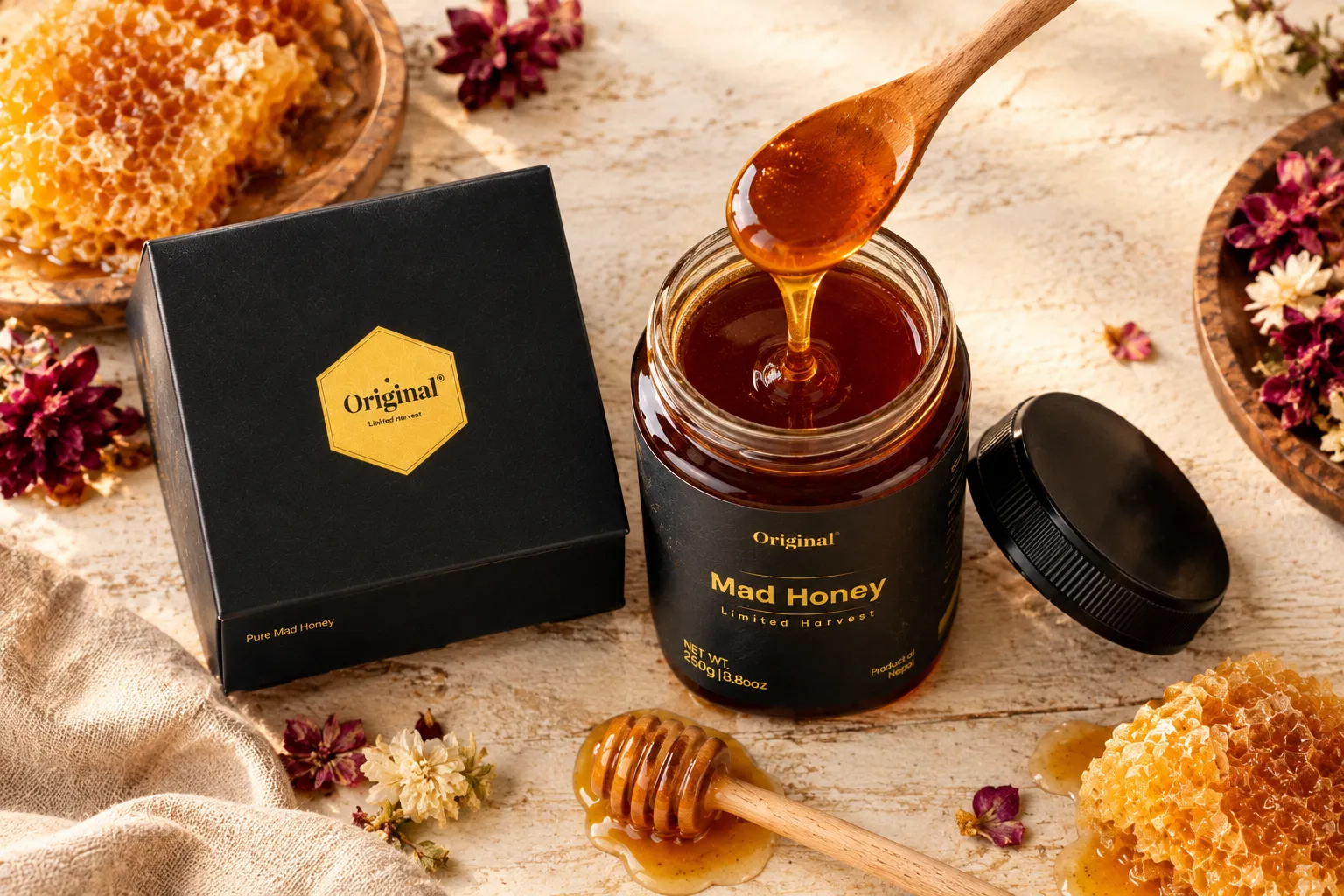
Then there is mad honey, a rare reddish honey produced in the high mountain regions of Nepal by the world’s largest honey bee, Apis laboriosa. Bees that forage on rhododendron flowers growing at extreme altitude produce honey containing natural grayanotoxins from the nectar, which is what gives mad honey its name and its very different effect compared to ordinary honey. This is the honey our own brand focuses on, and if you want to understand exactly what it is, how it is harvested, and how to use it responsibly, our guide on the Original Mad Honey homepage walks through the full story, and our buy mad honey page covers sourcing, dosage guidance and customer reviews in detail.
Is Honey Safe for Everyone? Babies, Dogs and Cats
This is where honey safety questions come up the most, and the answers are different for every group.
Honey and babies do not mix, ever, before the first birthday. The Centers for Disease Control and Prevention specifically warns that honey should not be given to children younger than twelve months, including in baked goods, formula or on a pacifier, because honey can carry Clostridium botulinum spores that a baby’s immature digestive system cannot handle safely, which can lead to infant botulism. Cooking or baking does not destroy these spores, so the rule applies to any form of honey, not just a spoonful straight from the jar. Once a child passes their first birthday, their digestive system is mature enough to process it normally.
Can dogs have honey? For a healthy adult dog, yes, in small amounts. The American Kennel Club notes that honey is generally fine as an occasional treat but recommends talking to your vet about quantity, especially for dogs with diabetes or weight issues, since a teaspoon of honey carries a meaningful amount of sugar. Most vets suggest keeping it to a small amount once or twice a week rather than a daily habit, and raw honey specifically should be avoided for puppies and dogs with weakened immune systems because of the same spore risk that applies to human infants.
Can cats have honey? Cats can technically eat a tiny lick of honey without immediate harm, but cats are obligate carnivores with no real nutritional need for sugar, and their smaller bodies process sugar less efficiently than a dog’s does. It is not a toxic food for cats the way chocolate or grapes are, but there is no upside to feeding it regularly, so most vets recommend skipping it as a treat for cats altogether.
Is honey vegan? This one is genuinely debated rather than clear cut. Honey is made by bees for bees, and strict vegan definitions exclude any product that comes from an animal, which is why most vegan diets avoid honey and reach for maple syrup or agave instead. Some beekeepers argue that small scale, sustainable beekeeping does not harm the colony, but the mainstream vegan position still treats honey as an animal product to avoid.
Honey as a Home Remedy
Honey has a long history as a folk remedy for a scratchy throat, and there is real research behind it. The Mayo Clinic notes that in several studies, a spoonful of honey before bedtime calmed nighttime cough in children over the age of one about as well as diphenhydramine, a common ingredient in over the counter cough medicine, and a Cochrane review of the same research reached a similar conclusion. The same rule from earlier in this guide still applies here though: honey as a cough remedy is only for children over twelve months old, never younger, because of the infant botulism risk.
Why Honey Comes in a Bear Shaped Bottle
If you grew up squeezing honey out of a plastic bear, there is an actual story behind that shape. According to Mental Floss, the honey bear bottle traces back to 1957, when Ralph and Luella Gamber, the founders of Dutch Gold Honey, were looking for a novelty container at a dinner with friends and landed on the idea that a bear likes honey, so why not sell honey in a bear. Their company never patented the design, which is why almost every honey brand today, including grocery store house brands, uses some version of the same friendly bear jar.
Honey has also earned its own place in music and film titles over the decades, from A Taste of Honey, a British play later turned into a well known film, to a long list of songs that borrow the word for the same reason beekeepers do, because honey has always stood for something warm, sweet and a little bit special.
Does Honey Expire, and Why Does It Crystallize
Does honey expire? Practically speaking, no. Pure honey has such low moisture content and such high acidity that bacteria cannot grow in it, which is why archaeologists have found pots of honey in ancient Egyptian tombs that were still edible thousands of years later. Can honey go bad? It can pick up moisture from a damp kitchen and ferment, or absorb odors if left uncovered, but that is a storage problem rather than the honey itself expiring. Keep your honey jar sealed, away from direct sunlight, and it will last essentially forever.
Why does honey crystallize? Honey is a supersaturated sugar solution, meaning it holds more glucose than water can normally dissolve. Over time, especially in a cool kitchen, that glucose naturally separates out into crystals, turning smooth honey grainy and pale. This is a completely normal process and is actually a sign you are dealing with raw, less processed honey, since heavily filtered commercial honey crystallizes more slowly.
How to decrystallize honey is simple. Do not microwave it, since that can scorch the honey and destroy the same beneficial enzymes that make raw honey worth buying in the first place. Instead, place the honey jar (with the lid loosened) in a bowl of warm, not boiling, water and let it sit for ten to fifteen minutes, stirring occasionally, until it turns liquid again.
Cooking and Baking With Honey
Honey shows up in kitchens far beyond a tea sweetener, and a few of the most searched honey recipes are worth breaking down.
How to make honey mustard is as simple as whisking equal parts honey and yellow or Dijon mustard together, then adjusting the ratio to taste with a splash of vinegar or a pinch of garlic powder if you want more depth. It works as a dip, a sandwich spread or a glaze for chicken.
How to make hot honey has become one of the biggest food trends of the last few years. Warm honey gently in a small saucepan, add red pepper flakes, a pinch of salt and a small splash of apple cider vinegar, then let it steep off the heat for twenty to thirty minutes before straining out the flakes if you prefer a smooth finish. What is hot honey, in short, is simply honey infused with chili heat, and it is popular drizzled over pizza, fried chicken and even ice cream.
How to make honey butter only takes two ingredients and a mixer. Beat softened butter with honey in roughly a two to one ratio until it is light and fluffy, then spread it on cornbread, biscuits or pancakes.
Honey baked ham gets its name from the sticky, caramelized glaze made by brushing ham with a honey and brown sugar mixture during the last stretch of roasting, letting it form a candy like crust as it heats.
For dessert, honey cake is a moist, spiced cake traditional in many cultures, often served around the Jewish New Year, where honey replaces most or all of the refined sugar in the batter. On the more nostalgic end of the shelf, snack brands like Little Debbie have built entire product lines, including honey buns, around the same sweet, sticky appeal that raw honey delivers naturally, just in a very different, mass produced form.
Honey Wine, Mead and Other Honey Traditions
Honey wine and mead are essentially the same thing: an alcoholic beverage made by fermenting honey with water and yeast, sometimes with fruit, spices or hops added. Mead is considered one of the oldest alcoholic drinks in human history, predating both beer and wine in many regions, because it required nothing more than wild honey, water and time to ferment naturally.
The phrase milk and honey shows up throughout ancient literature as a symbol of abundance and a land of plenty, and that cultural association is a big part of why honey still carries a sense of richness and reward across so many cuisines and traditions today.
Mad Honey: The Rarest Honey in This Guide
Most of the honey covered above is easy to find at any grocery store. Mad honey is not. It is harvested by hand from cliffside hives in remote parts of Nepal, and because it contains natural grayanotoxins from rhododendron nectar, it behaves very differently from a jar of clover or manuka honey and should always be used carefully and in small amounts.
If mad honey is a new term for you, our site has a full breakdown of what it is, where it comes from and how people use it on our homepage, along with dedicated pages covering the 250g jar and the 500g jar so you can compare batch details and customer reviews before ordering. Because mad honey’s legal status varies from country to country, we also keep an updated page on where mad honey is legal in the United States if that is something you need to check before purchasing.
Frequently Asked Questions About Honey
Is honey good for you?
Yes, in moderation. Honey contains antioxidants and trace minerals, and raw, less processed honey keeps more of these compounds than heavily filtered commercial honey, according to Healthline’s comparison of raw and regular honey.
Is honey vegan?
Most vegan diets exclude honey since it is produced by bees for the colony’s own use, which is why maple syrup and agave are the usual vegan substitutes.
Does honey expire or go bad?
Sealed, pure honey does not spoil because it has very low moisture and high acidity. It can ferment if moisture gets in or pick up odors if left uncovered, so keep the lid on and store it away from direct sunlight.
Why does honey crystallize, and is crystallized honey still safe to eat?
Honey crystallizes because it is a supersaturated sugar solution and the glucose naturally separates out over time. It is completely safe to eat and can be turned liquid again with a gentle warm water bath.
Can dogs have honey?
Healthy adult dogs can have a small amount as an occasional treat. The American Kennel Club recommends checking with your vet first, especially for diabetic or overweight dogs, and avoiding raw honey for puppies.
Can cats have honey?
A tiny lick will not poison a cat, but cats have no nutritional need for sugar, so most vets say it is better to skip honey as a cat treat altogether.
When can babies have honey?
Not before their first birthday. The CDC advises against giving honey in any form, including baked into food, to children younger than twelve months because of the risk of infant botulism.
What makes manuka honey different from regular honey?
Manuka honey comes from bees foraging on the manuka bush in New Zealand and contains methylglyoxal, a compound linked to antibacterial activity. It is graded on the UMF scale, and a higher UMF number means a higher concentration of that compound.
What is mad honey?
Mad honey is a rare reddish honey harvested from high altitude rhododendron forests in Nepal, produced by the giant Himalayan honey bee. It naturally contains grayanotoxins from the nectar, which is why it should be used carefully and in small amounts. You can read a full explanation on the Original Mad Honey homepage.
How do I decrystallize honey without ruining it?
Set the sealed jar in a bowl of warm, not boiling, water for ten to fifteen minutes and stir occasionally. Avoid the microwave, since high heat can destroy the enzymes that make raw honey worth buying in the first place.
References and Further Reading
- CDC, Foods and Drinks to Avoid or Limit in Infants
- American Kennel Club, Can Dogs Eat Honey
- Healthline, Raw Honey vs Regular Honey
- Mayo Clinic, Honey as a Cough Remedy
- Cochrane, Honey for Acute Cough in Children
- Unique Manuka Factor Honey Association, UMF Grading Explained
- Medical News Today, Honey Nutrition Breakdown
- U.S. News, Honey vs Maple Syrup: Which Is Healthier
- Mental Floss, Why Does Honey Come in Bear Shaped Bottles
The Bottom Line
Honey is a simple ingredient with a surprisingly deep story behind it, from the way honey bees turn nectar into honeycomb, to the reasons raw honey and regular honey behave so differently in your pantry, to the specific rules around who should and should not eat it. Whether you are reaching for a jar of everyday clover honey, splurging on a high UMF manuka honey, or exploring something as rare as mad honey, understanding what is actually in the jar makes it a lot easier to use honey well and enjoy it safely.