

Honey Benefits for Men: What Research Supports and What It Does Not
Honey benefits for men are real but modest. The best human evidence shows that honey can lower fasting blood sugar and cholesterol when it replaces other sugar, and that it
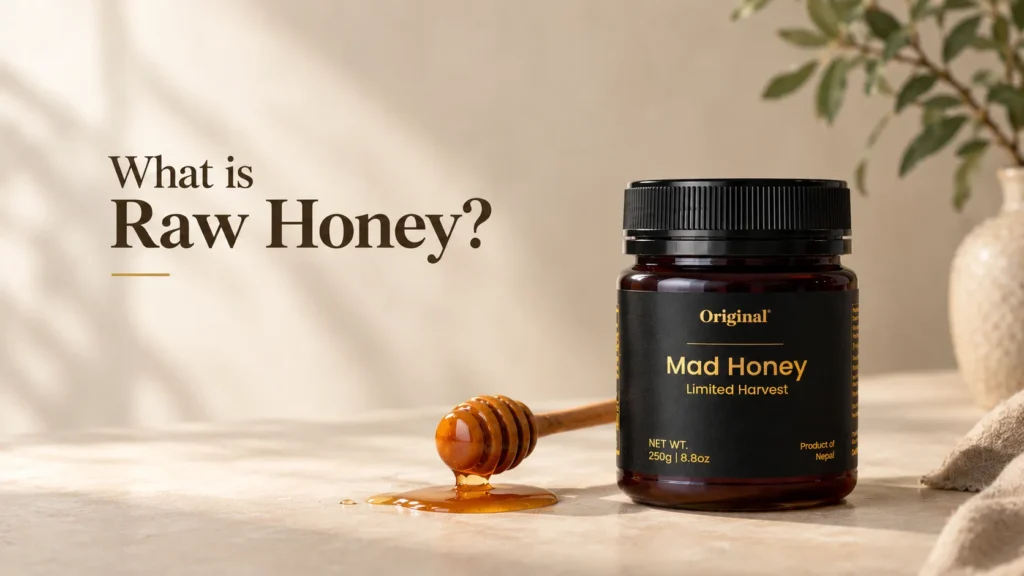
Raw honey is honey that goes from the hive to the jar without heat treatment or fine filtering. The beekeeper strains out wax and bee parts, and that is about it. This light handling leaves more pollen and plant compounds in the honey, which is why raw honey looks cloudy, feels thick, and sets into crystals sooner than the clear honey on most supermarket shelves.
There is a catch. No federal law in the United States defines the word “raw,” so the label alone proves very little. This guide explains what raw honey is, how it differs from regular honey, what it is good for, who should skip it, and how to buy a jar you can trust.
Here are the short answers before the detail.
Raw honey is honey taken from the comb and jarred with only the lightest handling. Bees make honey from flower nectar and store it in wax comb. For raw honey, the beekeeper uncaps the comb, spins the honey out, strains it through a coarse mesh to catch wax and bee parts, and bottles it. Nobody pasteurizes it, and nobody pushes it through a fine filter.
The National Honey Board, an industry body that works under USDA oversight, describes raw honey as honey as it exists in the hive, or as taken out by extraction, settling, or straining, with no heat added. The board also states that its definition has no legal authority.
That gap is the main thing to understand about raw honey. The FDA publishes labeling guidance for honey, but the agency says its guidance documents are recommendations, not enforceable rules. The USDA’s grade standards for extracted honey sort honey into grades A, B, and C by quality score, and they do not define raw honey. A few states step in. Utah, for example, wrote a definition into state law and allows the raw label only on honey that is minimally processed and not pasteurized.
Honey labels use overlapping words, and sellers often stack them for effect. Each word describes one thing only, as this table shows.
| Label word | What it usually means | What it does not tell you |
|---|---|---|
| Raw | Not pasteurized, with little or no added heat, and only strained | Where the honey came from, or whether the seller’s claim is true |
| Unfiltered | No fine filtering, so pollen and tiny particles stay in | Whether the honey was heated |
| Strained | Passed through a coarse mesh to remove wax and bee parts | Anything about heat |
| Pure | Nothing was added, such as syrup | Whether the honey was heated or fine filtered |
| Pasteurized | Heated to kill yeast, which keeps honey smooth and slows crystals | Whether anything was added |
| Organic | The farm follows organic rules | Whether the honey was heated or filtered |
A jar can be raw but not organic, pure but not raw, or unfiltered but still warmed. In the United States, organic honey only has to come from a bee farm that meets USDA organic standards, and nothing in that rule bans pasteurizing. If a seller uses only one of these words, ask about the others. A producer who handles honey carefully will tell you.
Processing is the difference. Regular honey is usually heated and fine filtered so it stays clear and liquid for months on a shelf. Raw honey skips both steps.
| Feature | Raw honey | Regular honey |
|---|---|---|
| Heat | Not pasteurized | Often pasteurized |
| Filtering | Strained only | Often fine filtered |
| Look | Cloudy or creamy, with color that varies by flower | Clear and uniform |
| Texture | Thick, and sets into crystals sooner | Stays liquid longer |
| Pollen | Some stays in | Often removed |
| Antioxidants | May keep more, since heat degrades some | May keep less |
| Flavor | Varies by flower and season | Milder and more uniform |
| Calories and sugar | About the same | About the same |
Two points are easy to miss. First, color and flavor come mostly from the flowers the bees visited, not from processing. Second, any honey can be diluted with cheaper syrup, so a raw label does not guarantee purity. For a longer side by side with more label terms, read our full guide to raw honey vs honey.
Bees turn nectar into honey by adding enzymes and fanning off water. According to the beekeeping supplier Mann Lake, bees dry the nectar to about 15 to 18.5 percent moisture before they cap each cell with wax, and honey that dry resists fermentation. Then the beekeeper takes over.
One more detail separates careful producers from careless ones. Some small producers warm honey slightly so it pours into jars. No law measures the line between gently warmed and heat treated, so ask the seller how they handle it.
Most people use raw honey as a flavorful sweetener, and a few uses make the most of it.
You can compare dozens of other honey types, from clover to manuka, in our complete honey guide.
Raw honey is a food, not a treatment. Some popular claims have support, and others do not.
| Claim | What the evidence shows |
|---|---|
| It has more antioxidants than regular honey | Heat can degrade some antioxidants, according to a 2023 review summarized by Healthline. Even so, Medical News Today notes that no large study shows raw honey is more nutritious than regular honey. |
| It eases cough | A Cochrane review found honey may relieve cough in children over one year old better than no treatment. The evidence was low to moderate in quality, and the authors found no strong evidence for or against using it. |
| It prevents seasonal allergies | Healthline reports no evidence behind this idea. Raw honey’s pollen can also trigger a reaction in a small number of people. |
| It is a safe sugar swap for diabetes | Honey raises blood sugar like other sugars. The nonprofit Oldways calls it a very concentrated sweetener. |
The nutrition facts are simple. A tablespoon of honey weighs about 21 grams and has roughly 60 to 64 calories and 17 grams of carbohydrate, almost all of it sugar, based on USDA FoodData Central entries. Honey also carries trace minerals, amino acids, and plant compounds, but not enough to count toward your daily needs.
Buy raw honey because you like its flavor and prefer less processing. Do not buy it expecting a medical result.
Raw honey is safe for most healthy adults, but a few groups should avoid it or talk to a doctor first.
If you feel sick soon after eating honey, with nausea, vomiting, or diarrhea, get medical help. If a baby has eaten honey and seems weak or unwell, get help right away.
Honey fraud is real, and a raw label does not stop it. The FDA tested 144 imported honey samples in 2021 to 2022 and found that 10 percent were violative, meaning they carried undeclared sweeteners. A second round in 2022 to 2023 flagged 3 percent of 107 samples, and the agency’s 2025 sampling again showed that honey stays open to fraud. The FDA found these cases with a lab method called stable carbon isotope ratio analysis. You cannot run that at home, and kitchen tricks such as dropping honey in water cannot match it.
So buy on proof, not on looks. Check these six things.
Appearance helps a little. Thick, cloudy honey that crystallizes fits the profile of raw honey. Honey that looks watery, foamy, or separated into layers does not, according to Healthline.
Raw honey keeps for a very long time when you store it well. Keep the jar sealed, dry, and at room temperature, away from direct sun, and use a clean, dry spoon.
Crystals are normal. Honey is mostly sugar, roughly 82 grams per 100 grams according to USDA FoodData Central, and glucose naturally separates out and forms crystals over time. Raw honey holds more pollen and fine particles that give crystals a place to start, so it sets sooner than regular honey. Crystallized honey is safe to eat, and many people spread it like butter.
To make it liquid again, follow these steps.
If honey foams or smells like alcohol or vinegar, it has fermented. Skip it.
Everything above applies to ordinary raw honey from honey bees kept in hives. Mad honey is a different product. Giant Himalayan honey bees make it on wild cliffs from rhododendron nectar, and it contains grayanotoxin, a natural compound that acts on nerve and heart cells. Hunters cut the comb straight from wild hives, so mad honey is raw by nature. For mad honey, though, raw is not the safety question. The grayanotoxin level is.
We sell Original Mad Honey, so we have a stake in this topic, and we want you to know it. We buy from Gurung honey hunters in Lamjung, Nepal, and each batch goes to a lab before we jar it. The batch number on the jar matches its report, and you can read a sample on our lab report page.
Mad honey is not an everyday sweetener. It is not for children, for anyone pregnant or breastfeeding, or for people with heart conditions or low blood pressure. Read our mad honey dosage guide and our guide to telling real mad honey from fake before you try any.
Raw and unfiltered honey has not been pasteurized and has not passed through a fine filter. The beekeeper only strains out large pieces of wax and bee parts, so pollen and tiny particles stay in the jar.
It depends on what you value. Raw honey keeps more pollen and tastes more varied, and heat may degrade some antioxidants in regular honey. No study shows a clear health advantage, and both are mostly sugar.
The benefits are mainly flavor and less processing. It may hold more antioxidants than heated honey, but the research does not show better health outcomes. Treat it as a sweetener, not a remedy.
No. Pure means nothing was added, and raw describes the handling. A jar can be pure but pasteurized, or labeled raw and still diluted by a dishonest seller. Look for both words and for proof behind them.
No. Organic describes the farm, and raw describes the processing. Honey can be one, both, or neither.
No. The CDC says not to give honey to any child under 12 months, raw or regular, because of the risk of infant botulism.
Raw honey raises blood sugar like other sugars. People with diabetes should count it in their carbohydrate plan and ask their care team about portions.
Not in a practical sense. Sealed honey stays safe for years, though the flavor can fade, and honey that has taken on water can ferment.
Honey is a sugar solution, and glucose forms crystals over time. Pollen and tiny particles in raw honey speed that up. Crystals do not mean the honey has spoiled.
Raw honey is honey with a lighter touch. It is not heated, it is only strained, and it keeps the pollen and character that fine filtering removes. It is not a medicine, and the word “raw” carries no legal guarantee in the United States. Buy it for the flavor, check the seller’s proof, and keep it away from babies under one year old.
We wrote this guide from the government, medical, and industry sources listed below. We sell wild raw honey, so we have a commercial interest, and we kept every claim tied to a source. To see what batch testing looks like, open a sample lab report. For other honey types and safety rules, read our honey guide, or browse our shop.
This article is for general education and is not medical advice. Talk to your doctor before you change your diet, especially if you have diabetes, allergies, or a weakened immune system, or if you are pregnant.
Honey benefits for men are real but modest. The best human evidence shows that honey can lower fasting blood sugar and cholesterol when it replaces other sugar, and that it
Medicinal mad honey is rhododendron honey that people have used as a folk remedy, mostly for digestion, pain and blood pressure. No human trial shows that it treats any of
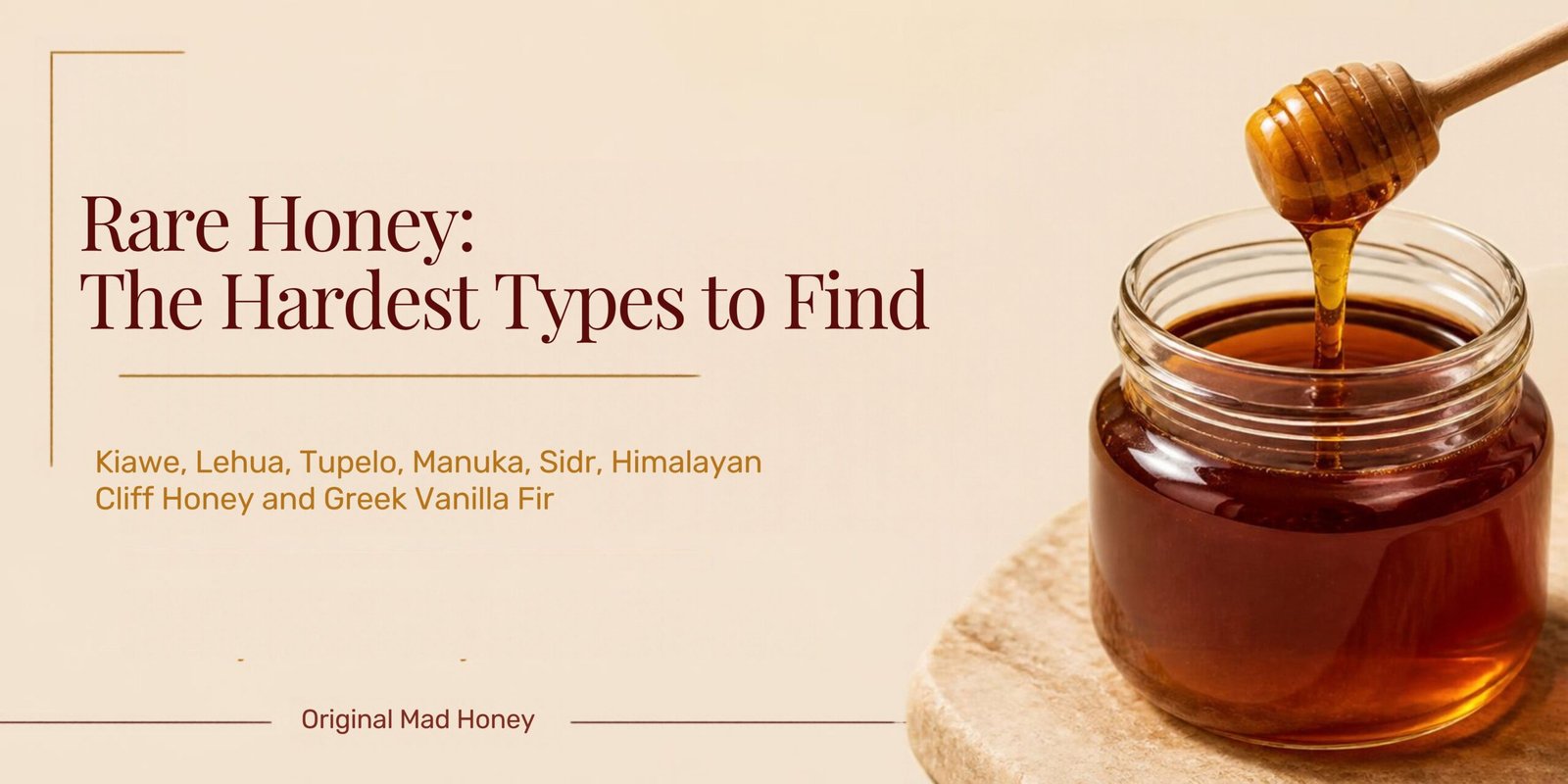
Rare honey is honey that few beekeepers can make in any given year. It usually depends on a single plant, a small patch of land, a bloom that lasts a