

How Long Does Honey Last? Shelf Life, Storage Tips, and Signs of Spoilage
Honey that is sealed, dry and clean can last for years, and well kept pure honey can stay usable long after the date printed on the jar. That is the
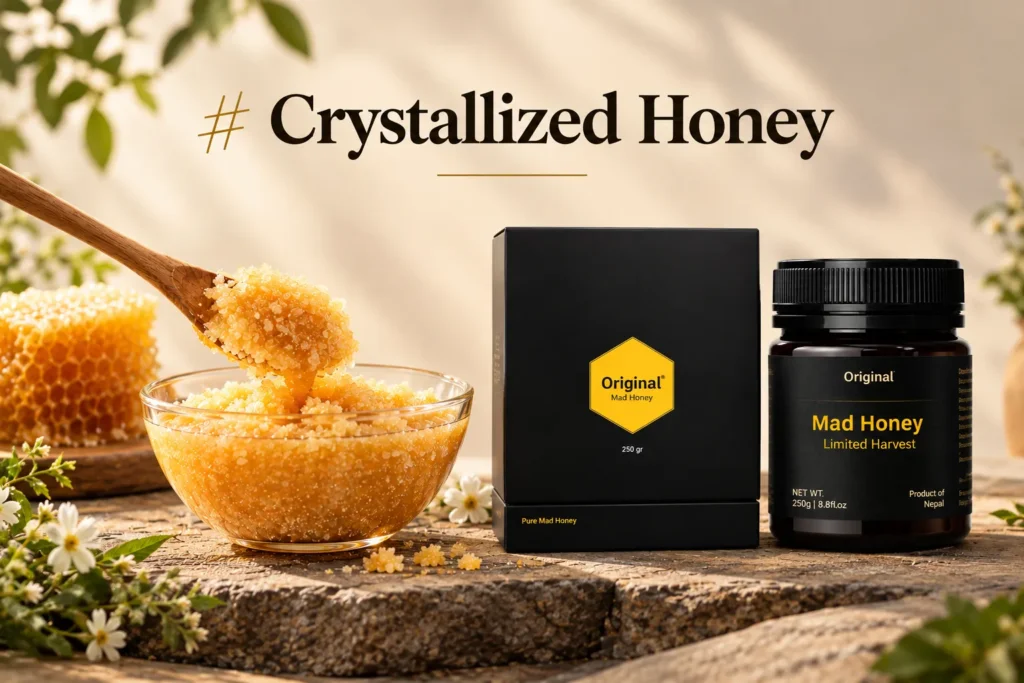
If you opened your honey jar and found it cloudy, thick, or full of grainy white crystals, you are not alone — and your honey has not gone bad. Crystallized honey is one of the most misunderstood things in the kitchen, and it’s actually a sign that you’re holding real, minimally processed honey in your hands.
In this guide, you’ll learn exactly why honey crystallizes, why crystallized honey is completely safe to eat, how to de-crystallize honey without destroying its natural enzymes, and how to store honey so it stays liquid for longer. We’ll also cover why raw, unprocessed honey — like real Himalayan mad honey — crystallizes faster than the filtered honey you find on supermarket shelves, and what that says about its authenticity.
Crystallized honey (sometimes called granulated honey, seeded honey, or creamed honey when the process is controlled) is honey that has partially or fully turned from a smooth liquid into a thick, semi-solid, sugary texture. Instead of pouring off a spoon, crystallized honey holds its shape, looks cloudy or opaque, and may feel gritty between your fingers.
This isn’t spoilage, fermentation, or contamination. It’s a completely natural physical change — the same honey, just in a different physical state. In fact, according to the National Honey Board, properly stored honey can remain safe to eat for decades, crystallized or not.
To understand why honey crystallizes, you need to understand what honey actually is: a supersaturated sugar solution. Honey is roughly 70–80% sugar (mostly glucose and fructose) and only 15–20% water. That means there’s more sugar packed into the water than the water can comfortably hold in a stable, dissolved state.
Because this solution is inherently unstable, the glucose in honey is constantly looking for a way to become more stable. Over time, glucose molecules lose water and bond together, forming glucose monohydrate crystals. Fructose, on the other hand, is far more soluble in water and stays liquid much longer — which is why crystallized honey often looks like a mix of solid crystals suspended in a thinner liquid layer.
Crystallization needs a starting point, called a nucleation site. Tiny particles naturally present in raw honey — pollen grains, fine air bubbles, beeswax fragments, and microscopic pre-existing sugar crystals — give glucose molecules a surface to latch onto. Once the first crystal forms, more glucose molecules attach to it, and the process spreads through the entire jar.
This is precisely why heavily filtered, ultra-processed honey stays liquid on store shelves for months: manufacturers strip out the pollen and micro-particles that trigger crystallization. Raw, unfiltered honey — the kind that still contains its natural pollen and enzymes — crystallizes much faster because those nucleation sites are still intact.
There’s no single answer, because crystallization speed depends heavily on the floral source of the honey. Some honeys begin forming visible crystals within a few weeks of extraction, while others can remain liquid for a year or longer. Here’s a general breakdown of common honey types and how quickly they tend to crystallize:
This variability is normal and expected. There is no “correct” timeline for crystallization — it’s simply a reflection of each honey’s unique sugar profile and how it was processed before it reached your pantry.
Because crystallization looks unusual compared to the smooth honey most people grew up with, a number of myths have taken root. Let’s clear them up one by one.
As covered above, this is false. Honey’s low water content and acidity make it one of the only foods that essentially never spoils. Archaeologists have even found edible honey in ancient Egyptian tombs thousands of years old — proof that crystallization, darkening, or thickening over time does not equal spoilage.
Crystallization is a physical change, not a chemical breakdown. The vitamins, minerals, antioxidants, and enzymes in honey remain intact whether the honey is liquid or crystallized. The only way honey loses these beneficial compounds is through excessive heat exposure — not through natural crystallization.
Even fully solidified honey can be restored to a liquid state or used exactly as it is. Solid, crystallized honey is often easier to portion for recipes, baking, or spreading, and many bakers and chefs actually prefer it in this form.
This is the exact opposite of the truth. Raw, high-quality, minimally processed honey crystallizes more readily than cheap, heavily filtered honey, precisely because it retains the natural particles needed for crystal formation. A honey that never crystallizes has often been processed specifically to prevent it.
Not all crystallization is accidental. Creamed honey (also called whipped or spun honey) is made by deliberately controlling the crystallization process to produce a smooth, spreadable texture instead of coarse, unpredictable crystals.
Producers do this by seeding liquid honey with a small amount of already finely crystallized honey, then storing the mixture at a cool, controlled temperature (usually around 57°F / 14°C) for one to two weeks. This encourages the formation of many tiny crystals rather than a few large ones, resulting in a texture similar to soft butter or peanut butter.
Understanding this process helps explain why crystallization isn’t something to fear — it’s a natural transformation that, in skilled hands, can even be turned into a desirable product in its own right.
This is the single biggest myth about honey. Crystallized honey is not spoiled, contaminated, or reduced in quality. It is simply undergoing a natural physical transformation — the sugar chemistry changes, but the honey itself is completely intact.
In fact, many honey experts argue the opposite of the popular belief: honey that never crystallizes is often the more suspicious jar. Commercial honey that stays liquid indefinitely has usually been heavily heat-treated and ultra-filtered, sometimes to the point of removing the pollen that allows the honey’s origin to even be verified. Genuine raw honey almost always crystallizes eventually — it’s a hallmark of authenticity, not a defect.
You can eat crystallized honey exactly as it is. Many people actually prefer it — it’s easier to spread precisely on toast, it doesn’t drip or run, and it holds its shape beautifully on a cheese board or in baked goods.
If you prefer your honey liquid, decrystallizing it is simple. The goal in every method is the same: gently warm the honey just enough to redissolve the glucose crystals back into solution, without overheating it and damaging its natural enzymes, antioxidants, and flavor compounds.
Important: Never boil honey or heat it above 120°F (49°C) for extended periods. High heat destroys delicate enzymes, degrades antioxidants, and can create harmful compounds like HMF (hydroxymethylfurfural) in overheated honey.
You can’t stop honey from crystallizing forever — it’s a natural process every pure honey eventually goes through — but you can slow it down significantly with the right storage habits.
The key to preserving honey’s natural enzymes, antioxidants, and delicate aroma compounds while de-crystallizing it is low, gentle, indirect heat. Always aim to stay below 104–110°F (40–43°C) if you want to preserve raw honey’s full nutritional profile — this mimics the natural temperature inside a beehive.
Raw, unprocessed honeys — including rare varieties like Himalayan mad honey — often behave differently from the filtered honey most people are used to. Because it is harvested directly from wild cliffside hives and never ultra-filtered or heat-pasteurized, it retains its natural pollen, wax particles, and enzyme content, which are exactly the nucleation sites that trigger crystallization.
This means genuine, minimally processed mad honey can crystallize or thicken over time, especially in cooler storage conditions — and that’s actually a good sign of authenticity rather than a flaw. If you want to understand more about what sets this rare honey apart, our guide on
If you want to understand more about what sets this rare honey apart, our guide on what mad honey is and how it’s harvested walks through its origin, harvesting process, and why it’s so different from ordinary honey.
Because raw mad honey is delicate and potent, we recommend using only the gentle warm-water method above if it thickens — never the microwave. For full guidance on safe consumption amounts, take a look at our mad honey dosage guide, and if you’re curious how it compares to regular honey in texture, flavor, and effects, see our breakdown of honey vs. mad honey.
One of the most practical uses of this knowledge is spotting adulterated or fake honey. Since crystallization is a hallmark of pure honey, its complete absence over long periods can be a red flag.
If you want honey you can trust for its purity, always buy from sources that are transparent about harvesting and processing. You can explore our own
If you’re looking for raw, minimally processed honey you can trust, browse our Original Mad Honey 250g jar or the larger Original Mad Honey 500g jar, both harvested directly from wild Himalayan cliffside hives.
No. Crystallization is a natural physical change in the sugar structure of honey, not spoilage. Honey has an extremely low moisture content and low pH, which makes it naturally resistant to bacteria and mold, so it does not spoil in the traditional sense.
Fast crystallization usually means one of three things: the honey has a naturally high glucose content (like clover or dandelion honey), it was stored somewhere cool (like a basement or near a window in winter), or it’s raw and unfiltered, meaning it still contains the natural pollen and particles that trigger crystal formation.
Yes. Crystallized honey dissolves quickly in warm liquids like tea, coffee, or warm milk. For baking, you can either use it as-is (it will melt during baking) or gently warm it first for easier mixing and measuring.
Store it at room temperature in a tightly sealed container, away from the refrigerator, direct sunlight, and repeated temperature changes. Using a clean, dry utensil every time you scoop honey also helps slow the process.
They come from the same process but are controlled differently. Creamed honey is intentionally seeded with fine crystals and controlled at a specific temperature to produce a smooth, spreadable texture, rather than the coarser, unpredictable crystals that form naturally over time.
Crystallization itself does not cause fermentation. However, if moisture gets introduced into the jar (from a wet spoon, for example) alongside crystallization, it can create pockets where fermentation is more likely. Keeping honey sealed and dry prevents this.
Crystallization does not chemically alter the sugar composition of honey, so its glycemic index remains essentially the same whether it’s liquid or solid. Any perceived difference usually comes from portion control — thicker, crystallized honey is easier to measure precisely than runny liquid honey, which can lead to smaller effective servings.
This is completely normal during partial crystallization. Because glucose crystallizes while fructose stays liquid longer, you may see a thicker, crystallized layer at the bottom of the jar with a thinner, more liquid layer on top. Stirring the honey redistributes both, and gentle warming will fully dissolve the crystals back into one uniform liquid.
Freezing honey (below 32°F / 0°C) can actually slow crystallization more effectively than refrigeration, because the extreme cold limits molecular movement almost entirely. However, this is impractical for most households — room temperature storage combined with an airtight lid remains the simplest, most effective approach for everyday use.
Crystallized honey isn’t a problem to be afraid of — it’s proof that you’re holding real, minimally processed honey. Whether you choose to gently warm it back to a liquid or simply enjoy it in its thick, spreadable form, your honey is just as safe, nutritious, and delicious as the day you opened the jar.
If you want to experience honey in its most authentic, raw form — pollen, natural crystallization tendency, and all — explore our full mad honey buying guide or check current mad honey pricing to bring home a jar of genuine, wild-harvested Himalayan honey.
Sources: National Honey Board FAQ, Savannah Bee Company, and The Best Honey Journal were referenced for general honey science in this article.
• National Honey Board — Honey FAQ
Honey that is sealed, dry and clean can last for years, and well kept pure honey can stay usable long after the date printed on the jar. That is the
There are four ways to sort the types of honey: by the flower the bees visited, by color, by form such as raw or creamed, and by the species of
Honey benefits for men are real but modest. The best human evidence shows that honey can lower fasting blood sugar and cholesterol when it replaces other sugar, and that it